Due to heavy rain in the forecast, tonight’s High Line Tour: From Freight to Flowers has been canceled. We look forward to seeing you on a future tour!


your inbox
Sign up for the High Line newsletter for the latest updates, stories, events & more.
Why the High Line’s plants need their winter “beauty sleep”
January 27, 2026
Strolling the High Line on a frigid January morning or crisp February afternoon, the spare winter landscape may seem to just be waiting out the cold until spring will spark the gardens back to life. In fact, winter is a critical phase in the lifecycle of plants native to the Northeast—an essential period of rest and rejuvenation, without which they would be unable to produce their spring spectacular of lush blooms and blossoms.
Time to chill
The plants you’ll find in the High Line gardens are not only hardy enough to survive the winter; they require, and depend upon, a sufficient season of cold weather to thrive. While plants do not exactly hibernate, they do put themselves into a dormant state during the winter months by producing a hormone called abscisic acid. During this deep “beauty sleep,” plants are preparing themselves for their reproductive cycle—the work of producing healthy and vibrant blooms in spring and summer. This period of rest, when temperatures hover between 32 – 45º F, is known as “chilling hours,” and getting enough time to chill out is crucial for the plants’ health.
We all know what it’s like to be sleep deprived, and it’s no different for our floral friends. The cold weather gradually breaks down the abscisic acid in plants, so they wake up in spring fully refreshed and weaned off their sleep aid. However, if a winter is too warm, the plants will awaken too early—groggy and foggy from the abscisic acid still in their system. They may produce weak fruit, sporadic blooms, or fail to leaf out at all. Without sufficient chilling hours, northern fruit trees like apples and blueberries will produce weak harvests.
On the High Line, our iconic milkweed, coneflowers, and Joe Pye weed count on winter to prepare their seeds for spring sprouting. As native Northeasterners, their seeds have tough outer coats. During the winter, as the earth freezes and thaws repeatedly, it causes the seed coats to contract and expand, forming cracks in the outer coat. This allows water to seep into the seed.
This process of stratification and scarification provides the seeds with the internal clock they need to accurately enter into, and emerge from, dormancy. Without it, they might sprout during an unseasonably warm week in November, and fail to germinate in spring, unable to detect that winter had run its course.
Flowering plants native to the Northeast—such as lilacs, tulips, and peonies—require prolonged exposure to cold weather in order to bloom in spring. Without at least several weeks exposure to temperatures between 41 – 45º F, the plant might produce leaves, but will not produce flowers. This process is known as vernalization, during which plants change their internal chemistry when they detect cold, and change it again when they sense warm weather. This transition from one phase to the other in response to the change in temperature triggers their reproductive cycle. If these plants never hibernate for the cold, they cannot “wake up” for spring.
While these processes are so important for healthy harvests and blooms that some gardeners will deploy various techniques to simulate optimal winter conditions during warm winters, the High Line does not grow fruit and does not interfere with nature. However, if a warm spring has bulbs sprouting ahead of schedule, we will cut back those areas a little bit earlier so that new growth has the room it needs.
Finally, winter is nature’s way of controlling pests and disease. While beneficial and native insects and pollinators have mechanisms for surviving the winter, sustained, invasive, and detrimental insects cannot endure sustained sub-freezing temperatures. The cold weather cleans gardens of pests like emerald ash borers, hemlock woolly adelgids, stink bugs, and slugs. Frigid winters also kill off fungal pathogens that cause disease.
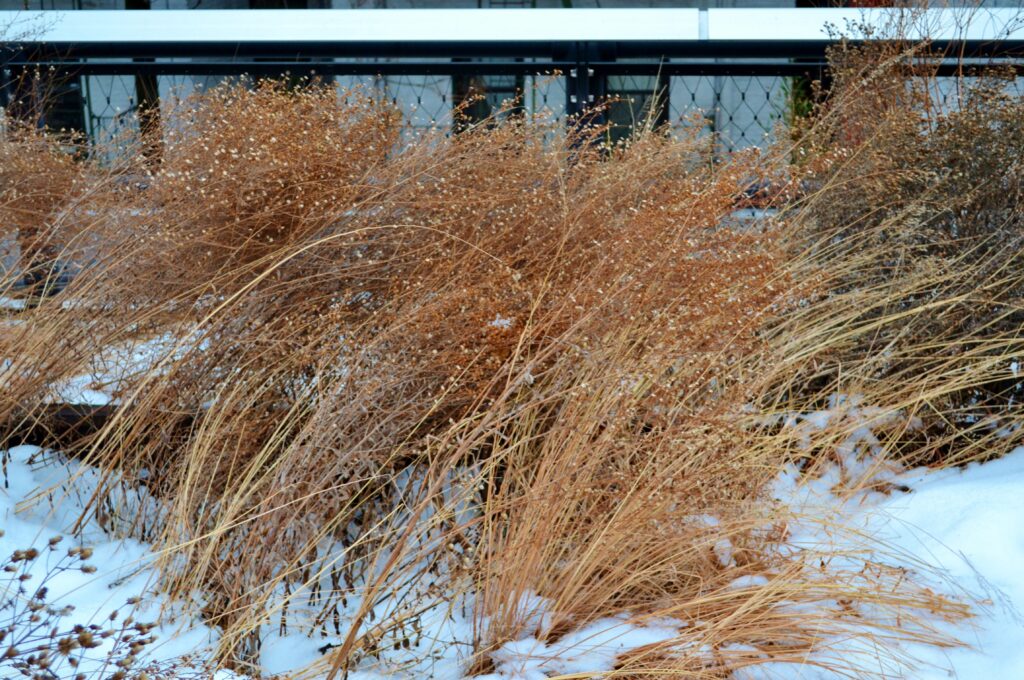
Photo by Gigi Altarejos
Snow: Nature’s fertilizer
As snow falls to the ground, it absorbs nitrogen—a vital macronutrient for plants—from the atmosphere. Nitrogen is an essential component of chlorophyll, the pigment that gives plants their green color and helps them absorb sunlight for photosynthesis, the process by which plants convert sunlight, carbon dioxide, and water into food and release oxygen. Nitrogen is also a building block for the amino acids that form the proteins and enzymes that promote growth, and is necessary for nucleic acids—plant DNA and RNA—the genetic material that directs growth and reproduction. For plants, nitrogen is essential for life.
However, plants cannot absorb nitrogen directly from the air. They absorb it from the soil, where microbes have first converted it into nitrate. By enriching soil with nitrogen, snow aids in providing plant life with this critical nutrient.
“Our garden team may find the snow shoveling that we help to do every year to keep the park open for visitors as a challenging endeavor, but we certainly appreciate the insulation and nutritional benefits that snow provides for our plants,” said Richard Hayden, the High Line’s Senior Director of Horticulture. “In fact, we do not fertilize or even add compost to our grassland gardens. They receive sufficient nitrogen and nutrients from the air and snow, and from the microbial re-processing from the up-to-50% of our roots that die off naturally.”
Shelter from the cold
Like their human counterparts, hardy Northeast plants are built to survive the winter, but not quite to endure prolonged exposure to extreme cold. When the ground actually freezes, it pushes plants out of the soil and can snap vulnerable roots—a process known as heaving. Snow provides a protective layer of insulation, maintaining a stable temperature of 32 degrees, preventing the ground from freezing and the heaving process.
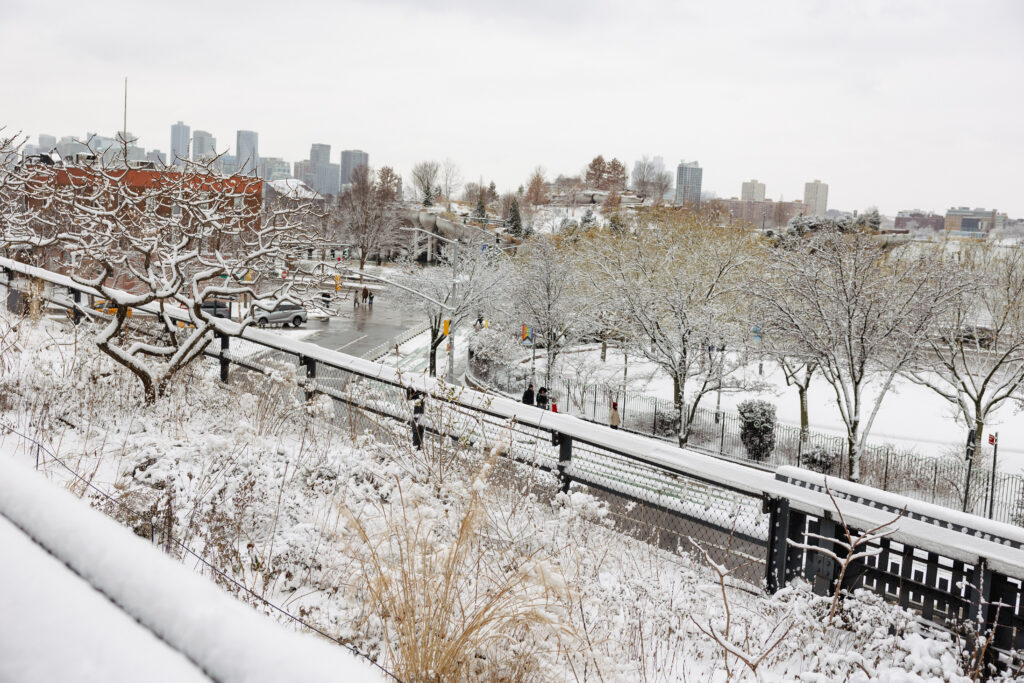
Photo by Liz Devine
Warming warnings
In New York City, historical data suggests optimal conditions for Northeast plants—average winter temperatures of highs in the 40s to lows in the 20s, with an average snowfall of about 30 inches annually. But climate change is steadily chipping away at these necessary conditions, threatening to disrupt these critical winter processes. Climate Central, an independent group of scientists and communicators who research and report facts about Earth’s changing climate, has found that winter temperatures in New York City have increased 2.2 degrees since 1970. This past year was the third-warmest year on record globally, and the fourth-warmest on record for the U.S. The winter of 2023 – 2024 was the warmest winter on record in the US and in New York City.
But neither the historical averages nor the Climate Central data reflects the increasingly erratic nature of weather, temperatures that fluctuate wildly between extremes, and the impact of this climate chaos on plant life. The unique conditions of the High Line—our plants grow in just 18 inches of soil on an elevated rail track, where they are exposed to more extreme cold and heat from above and below—make our gardens much more susceptible to climate chaos, and much more miraculous in their resilience.
“The amount of snow and the extreme fluctuations in winter temperatures have been very erratic as the years progress, meaning that sometimes our early spring flowering shrubs will wake up too quickly, and the flowering will be interrupted by a cold snap,” explained Hayden. “And our spring bulbs are starting to grow earlier and earlier every year as well, which may result in our starting the garden cutback process earlier as well. Growing plants 30 feet in the air on what is essentially a bridge means that warmer or colder air will be above and below the soil, making temperature extremes all the more impactful.”
Keeping our park in the sky operating year-round is only possible through the people-powered support of members like you. 100% of our annual operating budget is provided through donations.
Want to help us keep the High Line free and accessible to all New Yorkers and visitors? Consider making a donation to support the High Line today!
What should your next High Line adventure be? Take our quiz to find out! We’ll let you know your result and share links to explore based on your revealed interests and personality type.
Take the quiz