Due to heavy rain in the forecast, tonight’s High Line Tour: From Freight to Flowers has been canceled. We look forward to seeing you on a future tour!


your inbox
Sign up for the High Line newsletter for the latest updates, stories, events & more.
Kaela Mei-Chee Chambers
Eastern Aphasia Caress (EAC)
New York Public Library’s Andrew Heiskell Braille and Talking Book Library on 20th Street between 5th and 6th Avenues
Join artist Kaela Mei-Chee Chambers for a guided sensory tour of her Art Off Line commission, Eastern Aphasia Caress (EAC).
Saturday, October 4, 3 – 4:30pm
Learn more & RSVP
Saturday, November 8, 3 – 4:30pm
Learn more & RSVP
Kaela Mei-Chee Chambers is a transdisciplinary artist and educator. Her work, which weaves together text, imagery, and installation, is driven by what she refers to as an absurdist desire to define and quantify healing, a frantic need for structure in times of personal crisis, and the language constructed around that need. At times, Chambers’ work can seem so intimately personal and revealing that one might feel like a voyeur or an intruder, and yet, her vernacular and visual lexicon simultaneously inspire feelings of recognition and nostalgia. This most clearly manifests in her worksheet series, in which she mimics the structure and format of instructional worksheets, such as those used in therapeutic and clinical psychotherapy treatment, to convey feelings of anxiety, apprehension, insecurity, and anger, buttressed with equal parts sardonic humor and pathos. The precision throughout this series is evidence of the artist’s tireless efforts to adhere to self-created systems and rules. Every line is pristine, every blemish erased, every brushstroke and keystroke intentionally placed. This makes the unbridled moments, instances in which Chambers releases control or creates a mess, all the more captivating.
For the 2024 Art Off Line Commission, Chambers presents Eastern Aphasia Caress (EAC), presented in partnership with the New York Public Library’s Andrew Heiskell Braille and Talking Book Library on 20th Street between 5th and 6th Avenues. At its core, EAC is a reimagination of the Western Aphasia Battery (WAB), a diagnostic assessment administered by speech-language pathologists for language loss. The WAB prompts patients to identify text, objects (called “manipulatives”), and drawings of the objects (“stimulus images”). Chambers witnessed her mother undergo this assessment, spurred by her cognitive decline and loss of language due to late-stage brain cancer. Fascinated by the ways in which the WAB attempts to standardize this nuanced and individual experience, she was inspired to create a new version of the WAB, specific to her and her mother’s complicated relationship—”to give shape to the names of things I wish for her to recognize,” she notes. In lieu of quotidian objects like a pencil or a comb, the artist conceived of a kit that might instead remind her mother, “this is your daughter; this is tenderness; this is maternal love.” Chambers refers to this process as an effort to cope—with pain, with anger, with desire, and with memory.
The conceptual cornerstone and foundation of Eastern Aphasia Caress is a series of five art workshops hosted by Chambers in the Andrew Heiskell Library’s community room over the previous summer that were open to the public. During each session, attendees were asked to consider the question: what is a word you would want a loved one to know and remember? In other words, if you could create an aphasia kit for this loved one, what would you include and why? Participants were each given a worksheet packet created by Chambers, which guided them to describe and define their chosen loved one and chosen word, and to imagine what that word might look like as an object. Attendees then sculpted their word, and were asked to describe it yet again, this time as the form they made, not the one they initially imagined. The gulf between their intention and final delivery reflects Chamber’s interest in exploring failure, the subjectivity of language and meaning, and the impossibility of perfect translation.
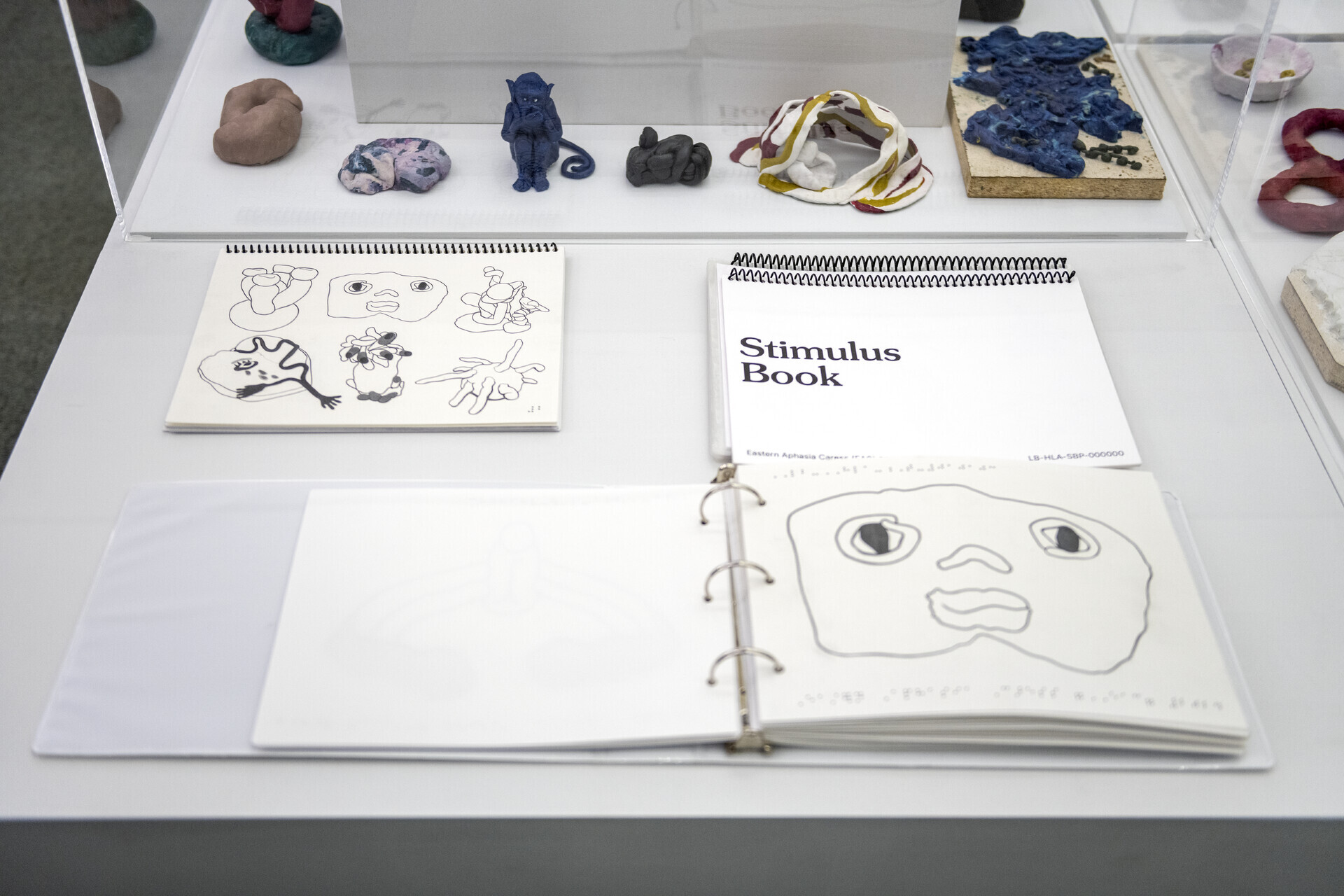
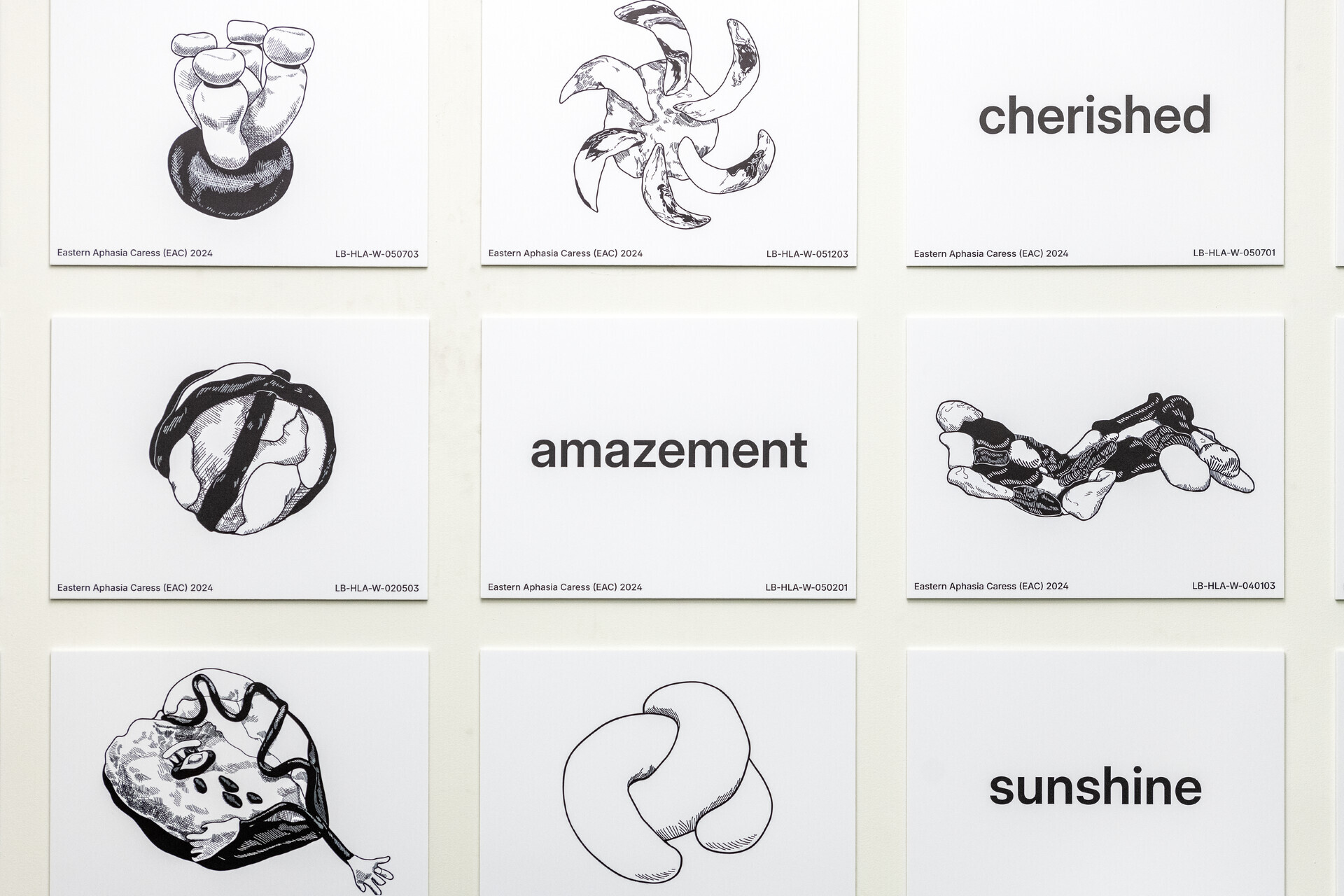
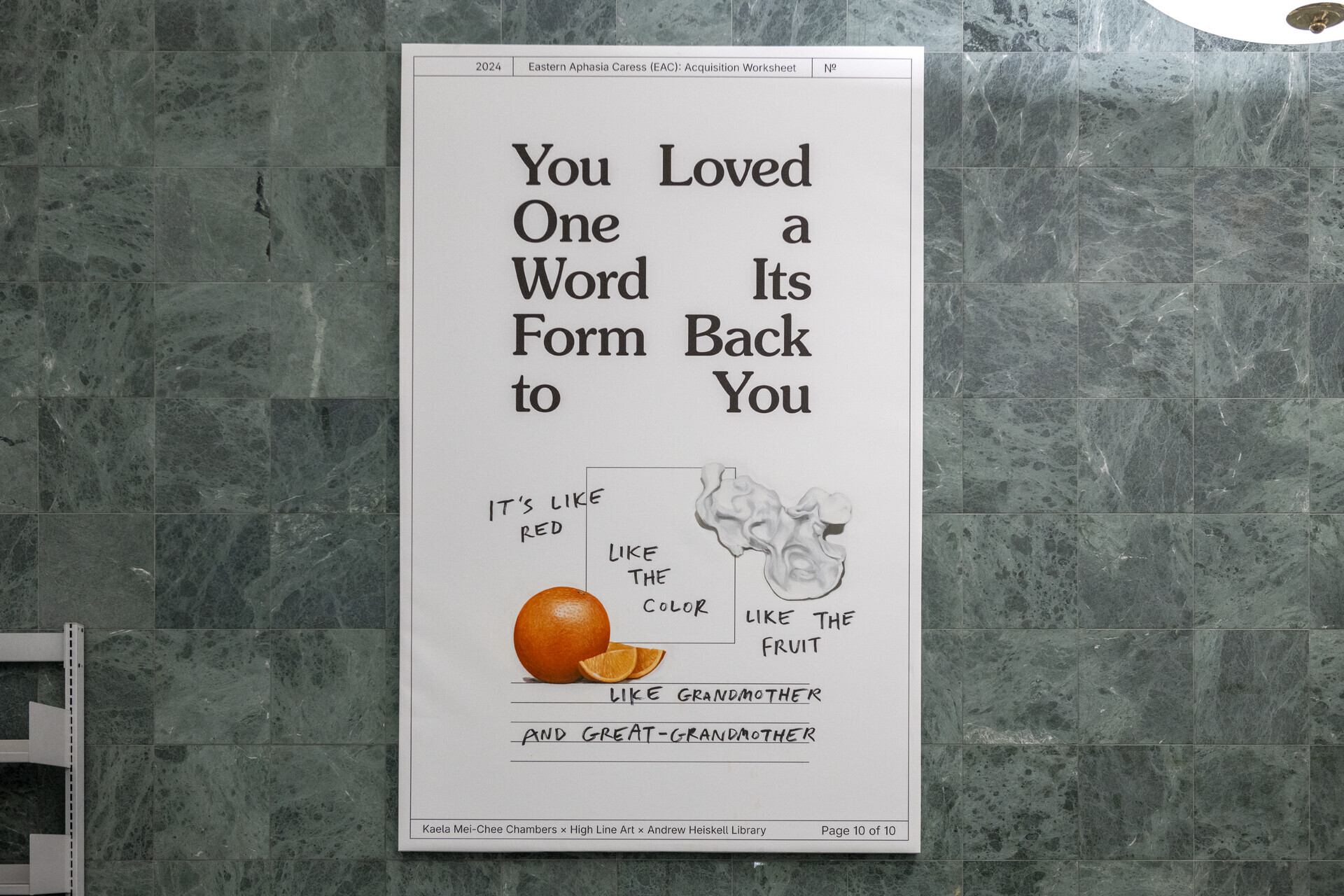
The final result is an ambitious installation composed of all 44 manipulatives made in the workshops by attendees, 44 high contrast stimulus drawings of the objects, each carefully and tenderly drawn by Chambers, a large-scale worksheet painting, and two tactile EAC “kits”—a collection of six manipulatives cast in resin available for the public to interact with, and a corresponding “stimulus book.” As a companion for the installation, Chambers created an index (available also in tactile and braille format) that walks viewers through each workshop participant’s contribution, including a description of their manipulative in their own words, a visual description written by Chambers, and a simple alt-text description. Together, these elements present an emotional, human antidote to the clinical, standardized Western Aphasia Battery. Eastern Aphasia Caress creates space for coping, while serving as a record of that very coping process. By welcoming others into this process, Chambers creates a public access library of words, people, and memories, and reveals a sensitive investigation into how language and description can shape our understanding and ability to connect with one another.
Read an interview with Kaela Mei-Chee Chambers on our blog →
Special thanks from the artist:
Thank you with all my heart to the 42 participants who contributed to this project, two of whom contributed twice: Evelyn von Gizycki, Shruti Sharma, Xena Brooks, Thérèse Jackson, Sonia Matos, Irma, Melissa, Tereza Chanaki, Angelica, Lee Light, Phoebe West, Natalya Nova, Mayan, Ashley Smart, Kiera Y. Johnson, Ruth C, Binna Kim, Liam Murray, Christian Amaya Garcia, C, K, Maude Lederman, Kiki, Catherine M. Barnes, Zoë Smith, Leon, Fiona, Lulu, Jessica Ortins, Zachary Schiller, Asima Jansveld, Sally, Noor, Jacqueline Garavante, Jon Kessler, Brenda Bregman, Jordan Wills, Krista Anna Lewis, Willie Zabar, Alex, Ray Barsante, and Pam Woodworth. Thank you to their Loved Ones. Thank you to my Loved Ones.
Thank you to Jessica Ortins, Avi Golden, and Georgina Kleege, who were so generous with their time and feedback.
Download the app

About Art Off Line
Art Off Line is a community-driven program of High Line Art that commissions new, temporary public art installations off the High Line, in collaboration with key partners on the West Side of Manhattan. The program seeks to establish an equitable model for the creation of public art, ensuring that local stakeholders—youth, neighbors, business owners, and community leaders—can shape their neighborhood’s unique cultural landscape.
High Line Art is dedicated to expanding the role of contemporary art in public spaces and, through Art Off Line, is committed to work alongside community partners in both the creative and curatorial process. Each year, a new partner has the opportunity to be part of the development of a public artwork at their site, from conception to execution. Through a collaborative visioning process between artist, curator, community, and site partner, each Art Off Line commission culminates in a year-long installation the whole neighborhood can be proud of.
Artist bio
Kaela Mei-Chee Chambers (b. 1993, New York, NY) lives and works in Jersey City, New Jersey. She has had solo exhibitions at galleries and institutions including Barnard College, New York, New York (2015); 266w25th St., New York, New York (2014); and Postcrypt Art Gallery, New York, New York (2012). Selected group exhibitions include Heaven Is a Different Thing, Unclebrother, Hancock, New York (2023); In Response: Jonas Mekas, The Jewish Museum, New York, NY (2022); Otherwise, Half Gallery, New York, New York (2022); and Columbia MFA Thesis Exhibition, Wallach Gallery, New York, NY (2022). Her work is in the permanent collection of Harvard Art Museums, Print Department, Cambridge, Massachusetts. Recent awards and residencies include the Rema Hart Mann Foundation Emerging Artist Grant, New York, New York (2024); MacDowell Fellowship, Peterborough, New Hampshire (2024); Skowhegan School of Painting and Sculpture, Madison, Maine (2023); Neiman Fellowship, LeRoy Neiman Center for Print Studies, New York, New York (2018); and Glasier Fellowship, Columbia University, New York, New York (2018).
Partner Bio
The Andrew Heiskell Braille and Talking Book Library provides free accessible reading material for patrons who are blind, low vision, physically disabled, or otherwise unable to read print materials. Heiskell Library offers materials to borrow in a wide range of formats, including braille, talking books, and magazines, for users of all ages, as well as players and apps. Patrons can also find accessible programming and events, individual coaching in assistive technology, group workshops, braille study groups, the Dimensions Lab for tactile creation, and more. To learn more, visit nypl.org/locations/heiskell or email talkingbooks@nypl.org.
Support
Lead support for High Line Art comes from Amanda and Don Mullen. Major support is provided by Shelley Fox Aarons and Philip E. Aarons, The Brown Foundation, Inc. of Houston, and Charina Endowment Fund.
High Line Art is supported, in part, with public funds from the National Endowment for the Arts, the New York State Council on the Arts with the support of Governor Kathy Hochul and the New York State Legislature, and the New York City Department of Cultural Affairs in partnership with the New York City Council, under the leadership of Speaker Adrienne Adams.
![[NEA LOGO] [NYS COUNCIL ON THE ARTS LOGO] [NYC CULTURAL AFFAIRS LOGO] [NYC COUNCIL LOGO]](https://fhl-website.s3.amazonaws.com/content/uploads/2023/04/31160959/HL_Art_YuJi_LogoRecog_31AUG23.png)