Due to heavy rain in the forecast, tonight’s High Line Tour: From Freight to Flowers has been canceled. We look forward to seeing you on a future tour!


your inbox
Sign up for the High Line newsletter for the latest updates, stories, events & more.
What creatures of the night tell us about the High Line
July 6, 2026
Last summer, the High Line made a remarkable and exciting discovery. In addition to the bees, butterflies, birds, and other insects that inhabited our gardens, it turned out that our wildlife habitats were attracting a robust population of bats. Specifically, they were stopping off to fuel up during their migration south for the winter, convening on the 23rd Street lawn to feast on our scrumptious supply of insects.
The study, conducted by the Urban Bat Project NYC, yielded such compelling and surprising results that we knew we had to continue our investigation. And, were we ever on to something! Since our report on last fall’s bat study, we’ve learned a lot more. With nearly half of the 40 bat species in the United States either threatened or endangered, the High Line is emerging as an important habitat for these essential members of our ecosystems.
“We recently got our first verifiable evidence of big brown bats on the High Line, which brings the total bat species biodiversity for the High Line up to four,” said Nic Camparato, founder of Urban Bat Project NYC and the leader of the study on the High Line. “As we only have five species of bat in NYC and one of those species is very endangered, to document four species is actually quite a milestone for a New York City park.”
And now, we’re offering the opportunity for the public to observe our bats. On July 22, park visitors are invited to “Bat Watching on the High Line,” where biologists with the Urban Bat Project NYC will clue you in on these mysterious visitors and let you eavesdrop on some secret bat communications—usually inaudible to the human ear—as they swoop overhead.
RSVP for Bat Watching on the High Line on July 22 →
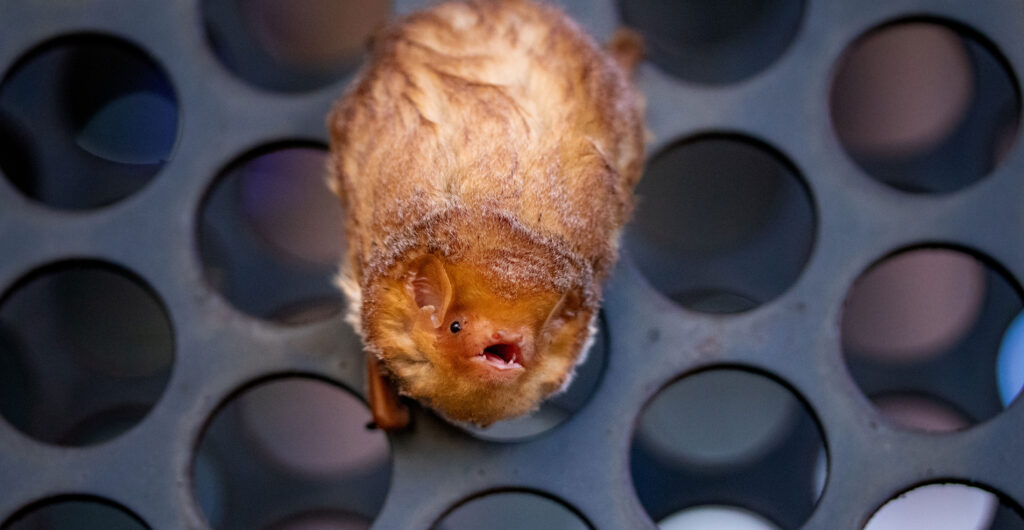
Photo by Ayinde Listhrop
The benefits of bats
From a New York City park to a tropical rainforest to a Midwest farm, bats are critical to both natural environments as well as crops and agriculture. With their voracious appetites, bats control pest populations. A bat can consume 50-100% of its body weight in insects every night—1,000 mosquitoes in an hour!—preventing diseases carried or spread by insects, and dramatically reducing the use of pesticides. Fruit bats are highly efficient seed distribution machines, dispersing seeds far distances through their droppings—known as guano—which does double-duty as a nitrogen-rich fertilizer. And, while the High Line’s bats are not pollinators, in other parts of the world, nearly 500 plants rely on bats for pollination. For these attributes, bats are known not only as nature’s pest controllers, but as nature’s farmers. Bats are also an important food source for birds of prey, mammals, and reptiles.
Bats are also extremely sensitive to the conditions of their environment. With their long life spans, fast metabolisms, and slow reproductive pace, bat populations are among the first to decline in response to stressors such as pollutants, habitat fragmentation, and climate change. This makes them the primary bioindicators of the health of an ecosystem. Negative fluctuations in bat populations usually signal broader loss of biodiversity. The High Line’s growing population of bats affirms our gardens as balanced, nurturing, and richly biodiverse wildlife habitats.
“Bats have historically gotten such a bad rap—portrayed as scary predators of the night—but they are really important members of the food web, scooping up loads of insect pests,” said Richard Hayden, Senior Director of Horticulture at Friends of the High Line. “We’ve had multiple sightings of red bats doing their daytime rest period in High Line trees. They really like our red cedars, and we’re thrilled to know these adorable little mammals can find a meal and a safe place to rest on the High Line.”
How we track bats
For scientists trying to track and study bats, these nocturnal creatures are not so much seen as they are heard—and then only through special devices that can detect and record bat sonar, the high-frequency, ultrasonic chirps and buzzes bats emit to navigate their environment and hunt prey. Through this process, known as echolocation, bats send out pulses, which create echos when they hit an object. Bats listen for these echoes, then crunch this data to calculate the size, shape, and location of the object. This biological mechanism allows them to map their exact surroundings in complete darkness and detect the tiniest of objects. Once a bat locks onto a food target, their chirps accelerate dramatically. From these rapid echoes, the bat’s brain can hone in on their prey with extreme precision. The sound of these rapid chirps and buzzes is known as a feeding buzz.
Bat detection devices record this sonar, producing audio graphs that scientists use not only to determine bat activity, but even to identify species. There are currently four bat detection devices recording bat sonar on the High Line, spaced out across the park. Each week, the devices are moved to new locations by the teens in our High Line Fellows: Emerging Leaders program—our paid employment and youth development program for New York City high school students—to gradually map the full scope of bat activity on the High Line.
While the discovery of the big brown bat was one of the more thrilling revelations of this phase of the study, the data also show that all of the bats have spread out considerably from the Lawn at 23rd Street. The 18th and 19th Street corridor and the Spur at 30th Street and 10th Avenue have been popular with the early migrating bats now visiting the park. At one point, the Spur was showing eight times the bat activity as other areas of the park.
“We’ve seen a lot of variation along the park, with some areas receiving a lot of activity and others very little,” Camparato said. “Eventually, we will be able to map out where the bat hot spots are on the High Line and which species are most attracted to them. Understanding which sections of the High Line are most valuable to bats can tell us a lot about how the park’s resources, as well as the buildings and streets that surround it, work together to influence bat movement.”
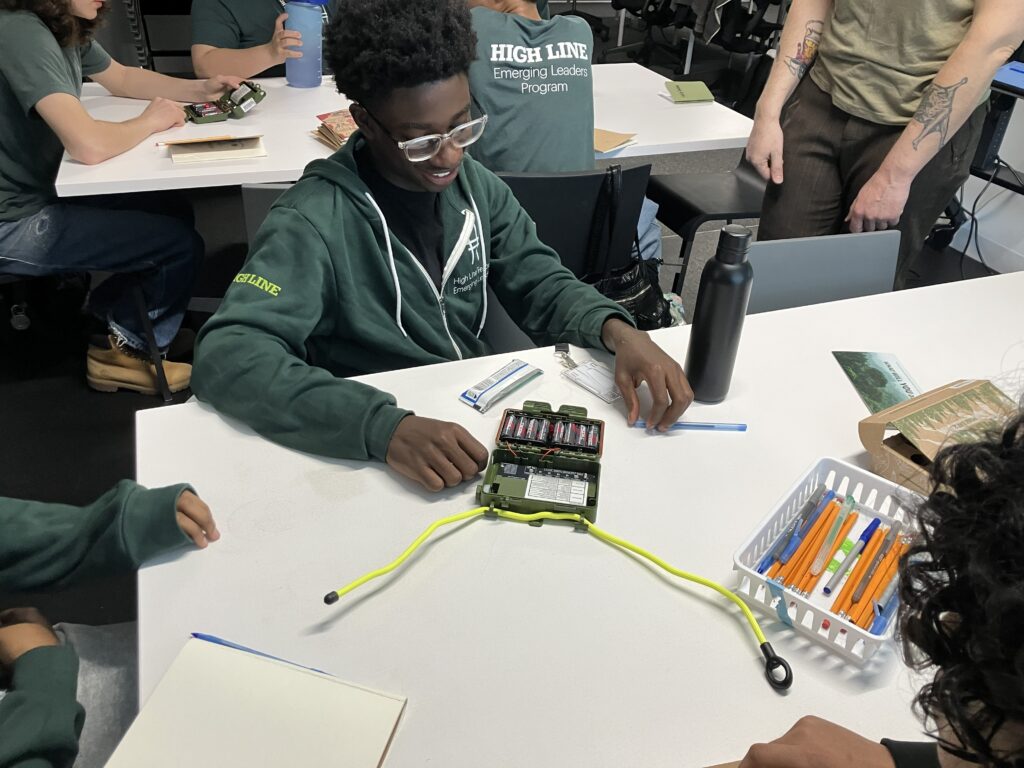
Photo by Janaira Ramirez
Our Fellows in the field
The High Line bat survey was conceived as a joint project between the Urban Bat Project NYC and the High Line Fellows: Emerging Leaders program—where the budding scientists and naturalists enrolled in the program’s horticulture learning pathway are doing much of the hands-on fieldwork. Through workshops and trainings with the Urban Bat Project NYC, the Fellows have learned how to operate and maintain the bat monitors, and how to evaluate the gardens to identify the areas that might be most attractive to bats. They are also studying the bats and learning how to interpret the data the study is collecting.
“Learning about the High Line’s bats is giving the horticulture Fellows the opportunity to dive deeper into the biodiversity that exists in our urban environment, and gain first-hand experience in field data collection,” said Janaira Ramirez, Youth & Career Development Program Manager. “It is teaching them about these important habitats and how they can research, support, and create that biodiversity.”
Learn more about our bats at our upcoming Bat Watching on the High Line program on July 22 →
The High Line’s thriving ecosystems of plants and wildlife, and the ecological benefits they provide to New Yorkers, are only possible through the people-powered support of members like you. 100% of our annual operating budget is provided through donations. Want to help shelter, nourish, and support our pollinators? Consider making a donation to support the High Line today!