Due to heavy rain in the forecast, tonight’s High Line Tour: From Freight to Flowers has been canceled. We look forward to seeing you on a future tour!


your inbox
Sign up for the High Line newsletter for the latest updates, stories, events & more.
Spring Cutback: Helping our gardens spring forward
March 12, 2025
There’s no question about who’s winning this first round of seasonal playoffs on the High Line. Signs of spring are sprouting up in every corner of the park, not the least of which are the teams working together in the gardens for our annual Spring Cutback.
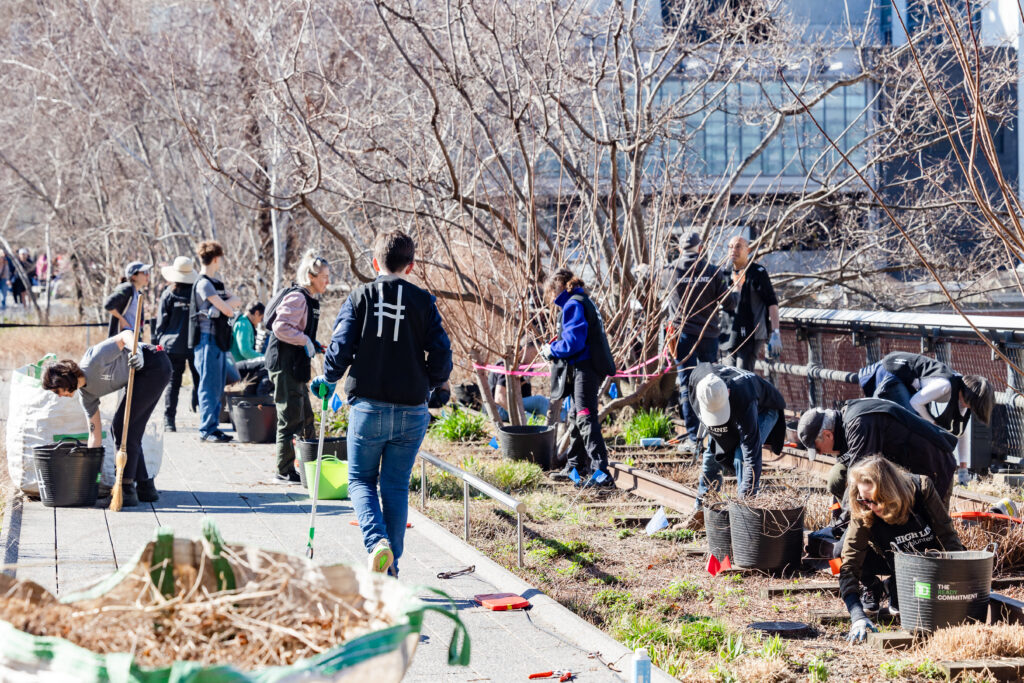
During Spring Cutback, our horticultural team leads nearly 200 volunteers—including our office staff, members, and corporate partners—in selectively trimming back the stalks, seedheads, and old growth from the previous year to make room for new spring growth. If you’ve visited the park over the past few months, you may have noticed that the High Line lets this old growth from the previous blooming seasons stand throughout the winter. We do this to provide year-round visual interest in the park for our visitors, but also to provide important nourishment and shelter for insects and birds. But, with our bulbs and shoots already pushing through the softening earth, it’s time for a little spring cleaning to help our gardens regenerate.
A window into our world
The High Line’s naturalistic, four-season garden zones were planned by renowned landscape designer Piet Oudolf to invoke the wild landscape that had sprung up on the High Line during its years as a disused elevated rail track. But, today, the gardens don’t grow by themselves. Spring Cutback is just one example of the painstaking work and careful planning required year-round to create that wild experience, and to nurture and maintain the park’s rich biodiversity.
Not only do our gardens grow in narrow, shallow beds atop the unique structure of a former elevated railroad bridge, but rail tracks run through them, and public artworks are installed throughout. Because of this added layer of complexity, mechanical equipment and machinery cannot be used in the High Line’s gardens. All 1.7 linear miles of our gardens are carefully cut back by hand—over the course of a month—by teams using scissors, shears, hedge clippers, and hand pruners.
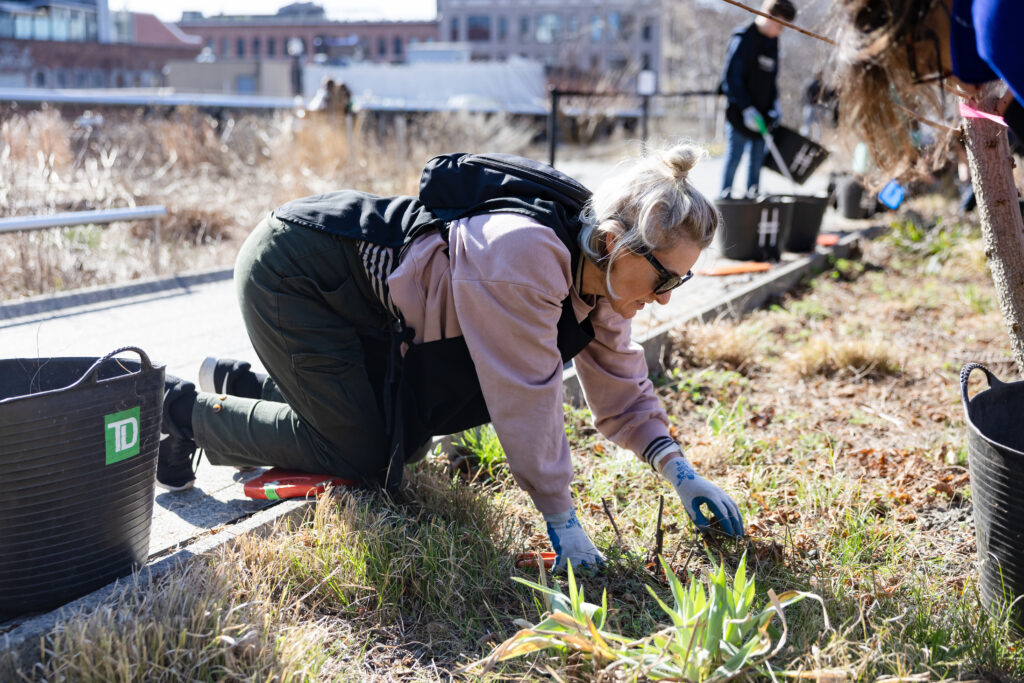
“Other naturalistic gardens have cutbacks, but it’s not as complex,” explains Richard Hayden, the High Line’s Senior Director of Horticulture. “They don’t have rails running through their beds, or as many shrubs or trees as the High Line. Some gardens can use string trimmers or mulching mowers. We have to do ours by hand, so it is very physically demanding work.”
A manual cutback is also necessary to ensure that the delicate habitats of bees and other pollinators that nest throughout the High Line are not disturbed. The High Line’s gardens provide sources of nectar and pollen in almost every season, and several species of bees make their homes in our old growth and overwinter on the park. For example, the tiny leafcutter bee—a bee no larger than an ant—nests in the slight stems of plants such as wild petunias, which are about the size of a coffee stirrer.
Around the end of February, these precious habitats begin to compete with spring bulbs that, due to warmer winters and shifting seasons, are demanding their space in the gardens ever earlier. The cutback must be carefully timed to give the bulbs the room they need without jeopardizing the food and housing our birds and bees still need from our old growth.
“If we’re really focusing on the ecological service of the garden, we want to keep the winter growth as long as possible, so we try to strike a delicate balance with spring ephemerals coming up earlier,” said Yuki Kaneko, the High Line’s Senior Horticulture Manager. “Also, the earlier in the year it is, the colder it is going to be when we’re asking people to volunteer. March is a happy medium.”
While some of last year’s growth is always left untouched for these purposes, Spring Cutback produces over 100 cubic yards of garden debris, much of which is turned into compost and returned to the gardens for nourishment. Some of the debris is also repurposed for other park projects—like the scarecrows crafted from our tall grasses that decorate the park during Halloween.
“It’s great to have the opportunity to utilize the cutback materials in creative ways,” Hayden says.
The human touch
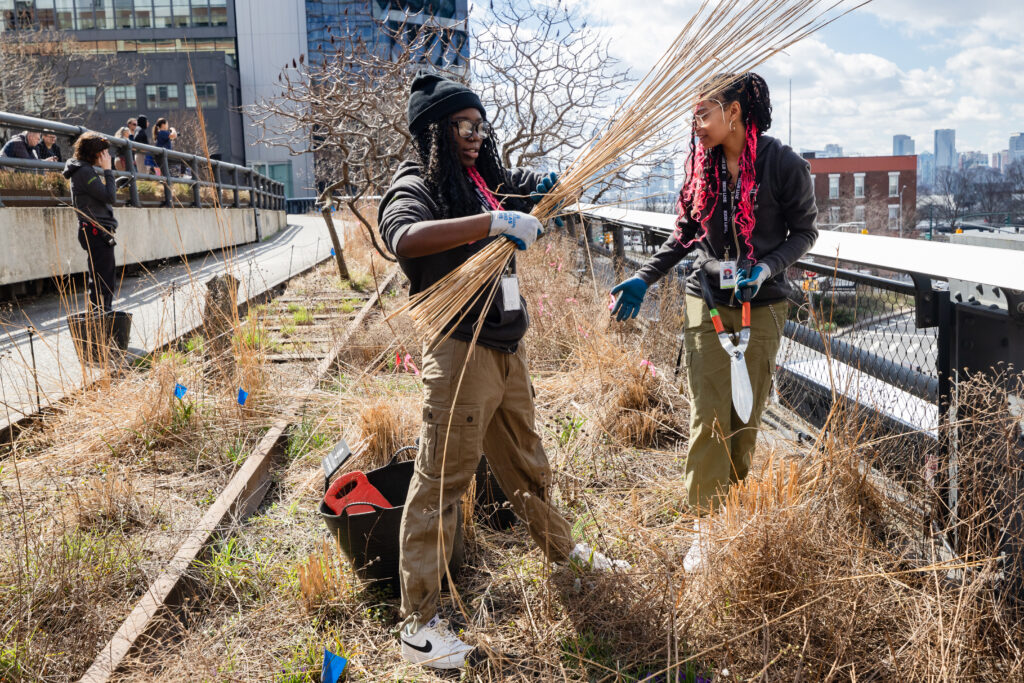
One of the most important species contributing to the High Line’s bustling ecosystem are human beings, whose appreciation and support of the park are vital to its success. In addition to keeping our gardens healthy and vibrant, Spring Cutback creates the beauty that attracts our human visitors and is the High Line’s largest volunteer opportunity for park supporters.
Under the supervision of our horticultural team, nearly 200 volunteers from among our Horticulture Partners, corporate sponsors, teaching artists, High Line fellows, donors, members and local community organizations, participate. Even some of our office staff take a break from their desk duties to get their hands dirty. This event helps build a sense of connection and community between our supporters and our park, and also serves to educate this public audience about the complexities of operating and maintaining a park that’s “wild by design.”
“We have volunteers who come back year after year, some for more than a decade,” Hayden says. Some of these volunteers eventually develop the knowledge and skill to join the ranks of our Horticulture Partners—a group of highly skilled, volunteer gardeners who assist our horticulture staff during the growing season.
Spring Cutback is an enormous undertaking by our horticultural team, who spend months planning the cutback and working with teams across Friends of the High Line to recruit and schedule volunteers. It’s a precision operation that Hayden compared to a chess game. Staffing is limited to about 25 volunteers per shift, and given the physical demands of the work, gardening tasks have to be matched to both the volunteer group working that day and the garden zone ready for cutback, as well as organized to balance the more strenuous work with less demanding duties.
Excluding the growth left behind for insect habitats, the High Line cuts back its plants to uniform heights. This makes for neat, attractive gardens for our visitors to enjoy until spring is in full bloom, and is another feature demanding the precise work of a manual cutback. And, before volunteers can get their hands dirty, they undergo extensive training in the techniques required to maintain the High Line gardens.
From balancing the needs of the bulbs and bees competing for space, to creating the beauty and experiences that form human connection, to providing our volunteers with the health benefits of having access to nature, Spring Cutback is just one example of how thoughtful human intervention keeps the High Line’s complex ecosystem buzzing and blooming in harmony. It also demonstrates why stewardship is so important in supporting nature in urban environments, and how the High Line continues to lead the way in practices that help New York City thrive.