Due to heavy rain in the forecast, tonight’s High Line Tour: From Freight to Flowers has been canceled. We look forward to seeing you on a future tour!


your inbox
Sign up for the High Line newsletter for the latest updates, stories, events & more.
Raven Halfmoon
West Side Warrior
On the High Line at Little West 12th Street
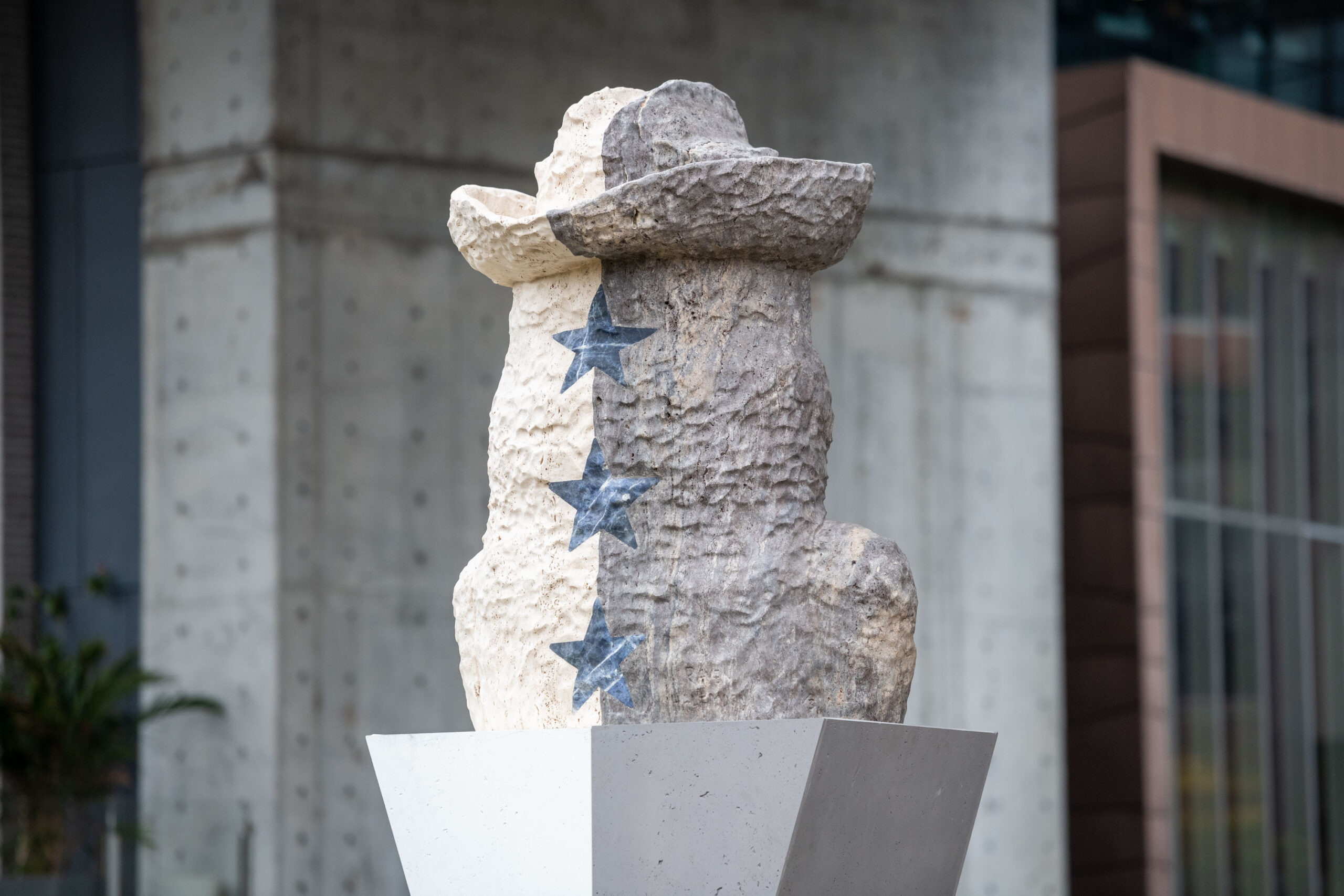
Raven Halfmoon’s practice ranges from torso-scaled to colossal-sized stoneware, bronze, and stone sculptures that honor her Caddo heritage. Born and raised in Oklahoma, she was first introduced to traditional Caddo pottery techniques by a Caddo elder. The Caddo Nation is a Tribal Nation whose ancestral homelands encompass what is now large parts of Louisiana, Texas, Arkansas, and Oklahoma. Caddos are known for their engraved, incised, and distinctly styled pottery, and hand-built various vessels using a coil method. Halfmoon uses this knowledge to inform her contemporary practice, combining these traditional techniques with references to current pop culture. With inspiration that ranges from ancient earthwork construction and Indigenous pottery to the monumental sculptures on Easter Island, Halfmoon examines the intersection of tradition, history, gender, and personal experience. She fuses Caddo imagery, such as stars or symbols representing the Red River, with contemporary gestures—tagging and glazing her work like a graffiti artist. Halfmoon’s expressive surfaces, marked with her deep finger impressions, assert her presence for all those who see the work, countering a history of silencing Indigenous voices.
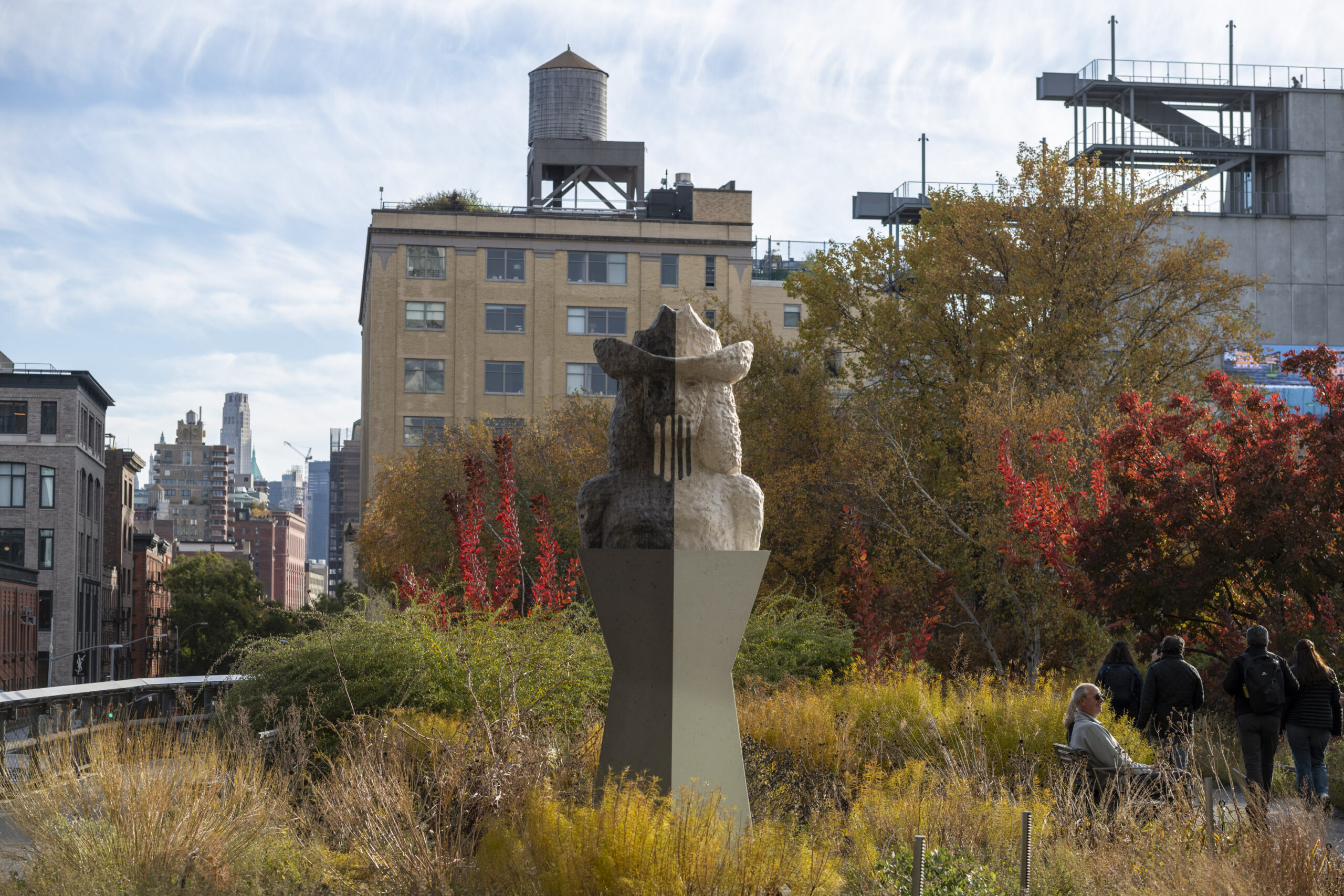
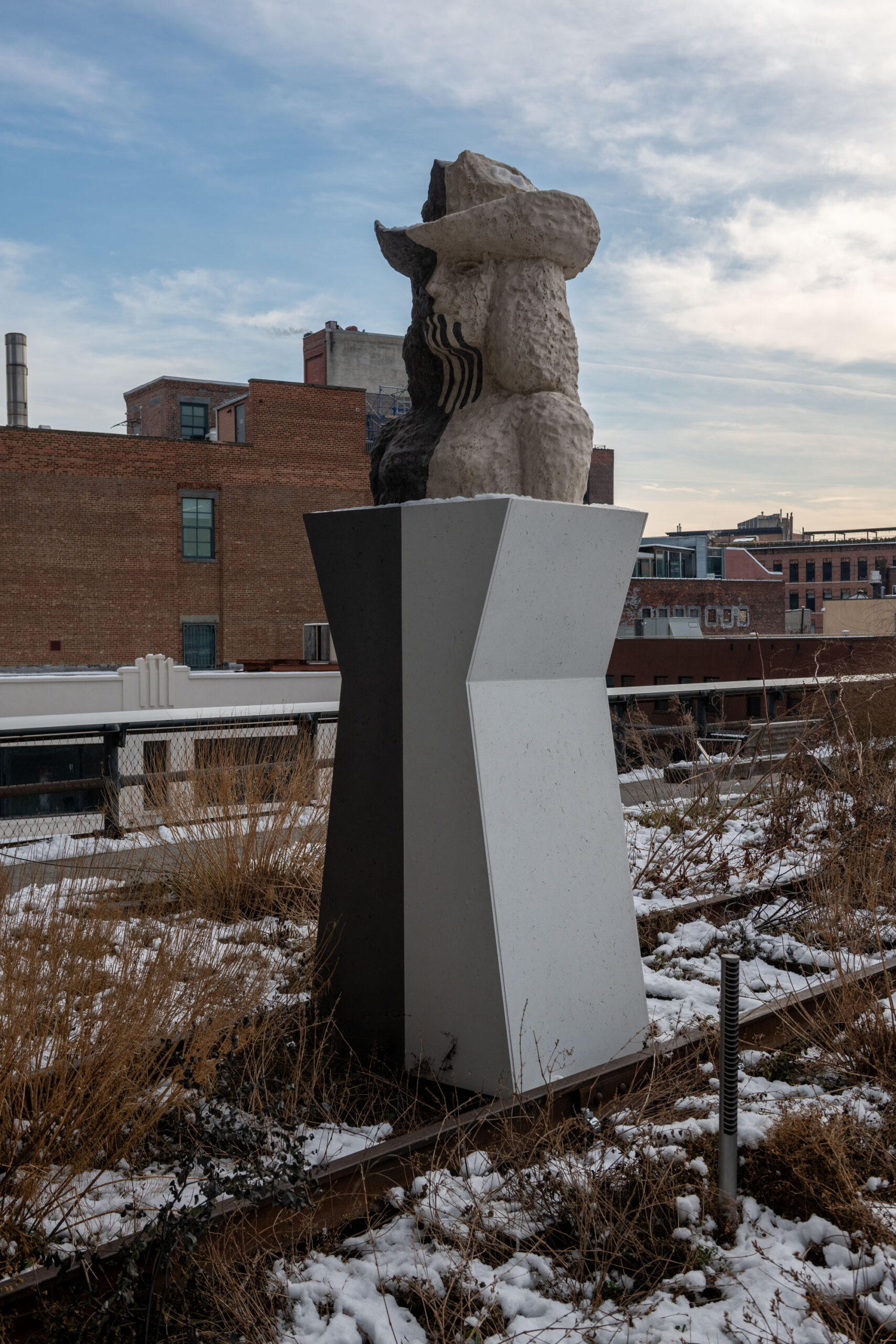
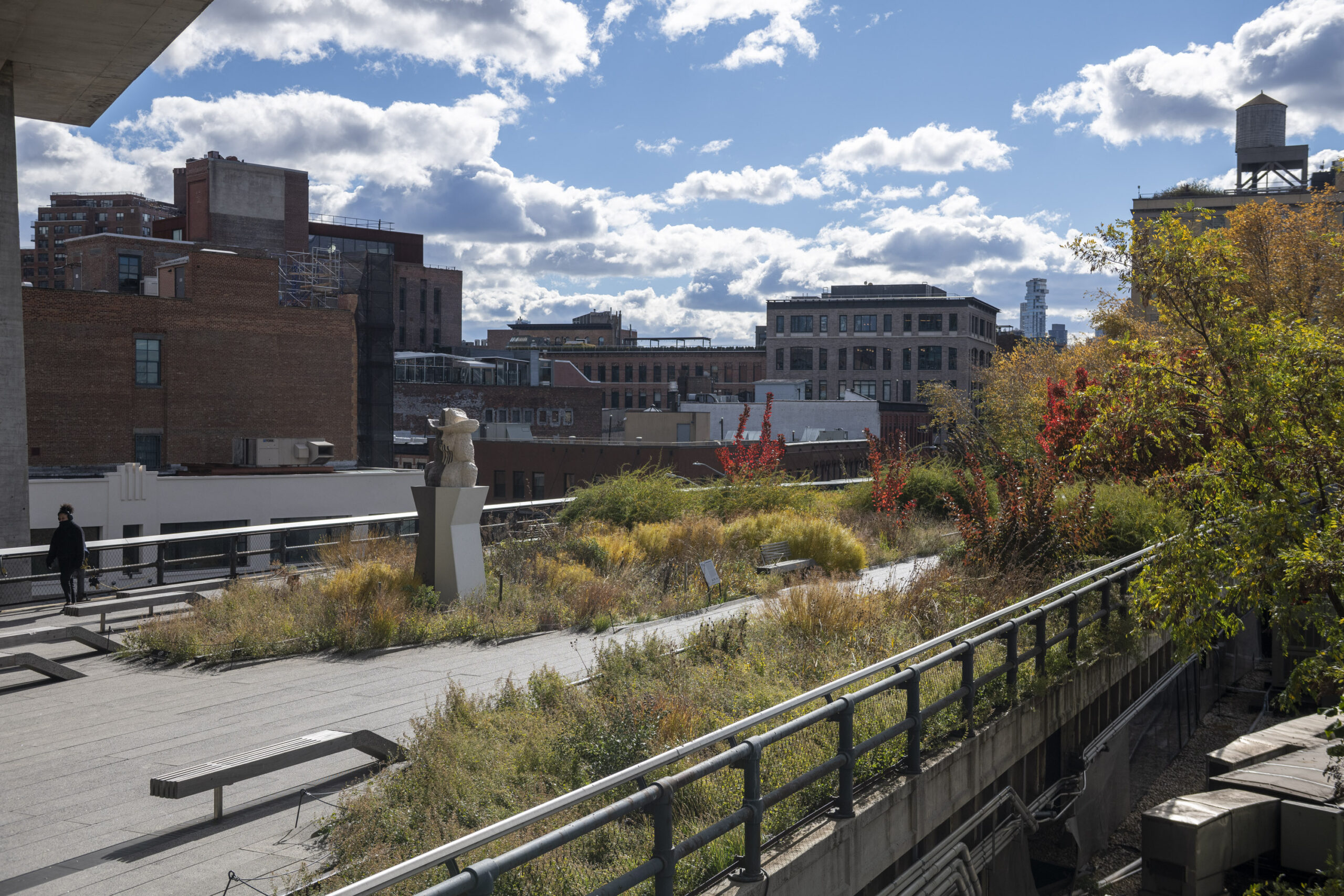
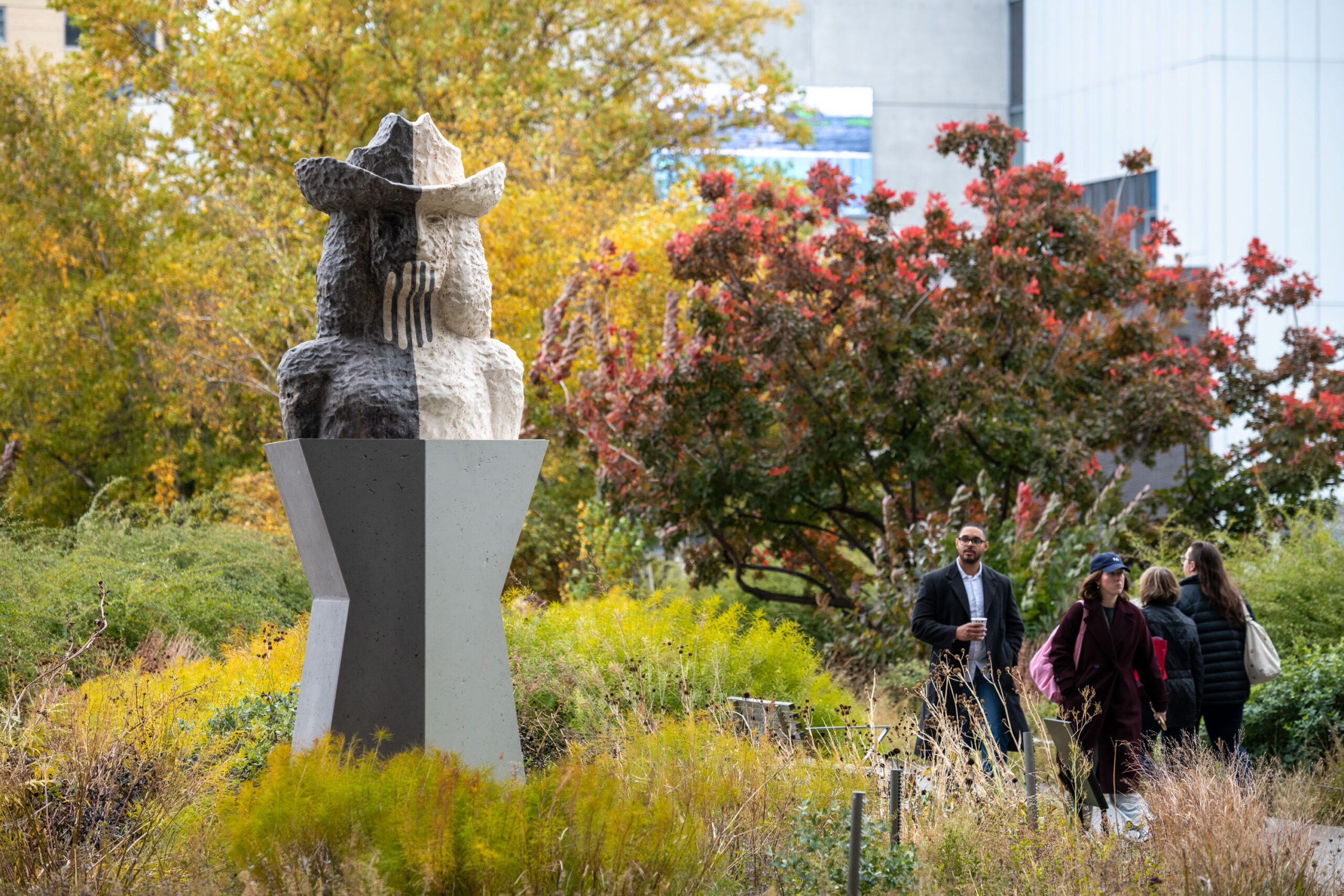
For the High Line, Halfmoon presents West Side Warrior, a towering bust of a Native female horse rider. Historically, busts have been commissioned to commemorate aristocrats, rulers, or military leaders. Halfmoon subverts these traditions, depicting an unidentified Indigenous woman with facial tattoos wearing a cowboy hat. While the work is a nod to the artist’s heritage and connection to the American West, it also references the High Line’s history.
In the mid-19th century, the railway company employed men on horseback, called the West Side Cowboys, in an effort to reduce rates of pedestrian injury and death from street-level freight trains. Eventually, the cowboys were phased out, and the freight line was elevated off the street—creating what we now call the High Line.
Artist bio
Raven Halfmoon (b. 1991, Caddo Nation) lives and works in Norman, Oklahoma. Halfmoon has held solo exhibitions at institutions including, Kemper Museum of Contemporary Art, Kansas City, Missouri (2025) (forthcoming); Parrish Art Museum, Water Mill, New York (2025); The Contemporary Austin, Austin, Texas (2025); Bemis Center, Omaha, Nebraska (2024); Aldrich Contemporary Art Museum, Ridgefield, Connecticut (2023); Art Omi Sculpture Park, Ghent, New York (2022); and Missoula Art Museum, Missoula, Montana (2022). She has participated in major international group exhibitions, including, Once Within a Time, the 12th SITE SANTA FE International, Santa Fe, New Mexico (2025); Several Eternities in Day: Brownness and the Spiritual Turn in Contemporary Art, Hammer Museum, Los Angeles, California (2025) (forthcoming); Smoke Gets in Your Eyes, Kemper Museum of Contemporary Art, Kansas City, Missouri (2024); To Take Shape and Meaning: Form and Design in Contemporary American Indian Art, North Carolina Museum of Art, Raleigh, North Carolina (2024); The Land Carries Our Ancestors: Contemporary Art by Native Americans, National Gallery of Art, Washington D.C. (2023); Indian Theater: Native Performance, Art and Self Determination since 1969, Hessel Museum of Art, Annandale, New York (2023); Material Issues: Strategies in 21st Century Craft, Utah Museum of Contemporary Art, Salt Lake City, Utah (2021); and Meditation on a Bone, Heide Museum of Contemporary Art, Melbourne, Australia (2019).
Support
Lead support for High Line Art comes from Amanda and Don Mullen. Major support is provided by Shelley Fox Aarons and Philip E. Aarons, The Brown Foundation, Inc., and Charina Endowment Fund.
High Line Art is supported, in part, with public funds from the New York State Council on the Arts with the support of Governor Kathy Hochul and the New York State Legislature, and the New York City Department of Cultural Affairs in partnership with the New York City Council, under the leadership of Speaker Adrienne Adams.
Major support of High Line Art digital infrastructure is provided by Bloomberg Philanthropies.
Additional support is provided by Agnes Gund.

Special thanks to Salon 94.
Sobre esta obra
La práctica escultórica de Raven Halfmoon (nacida en 1991, Nación Caddo) rinde homenaje a su herencia caddo, una Nación Tribal cuyas patrias ancestrales abarcan lo que ahora son grandes partes de Luisiana, Texas, Arkansas y Oklahoma. Halfmoon, quien se inspira en la construcción ancestral con tierra y la cerámica antigua, así como en las esculturas monumentales de la Isla de Pascua, examina la intersección de la tradición, la historia, el género y la experiencia personal. Fusiona técnicas e imágenes caddo, como estrellas o símbolos que representan al Río Rojo, con gestos contemporáneos, y firma y esmalta sus obras como si fuera artista de grafiti. Las superficies expresivas de Halfmoon, marcadas por sus impresiones profundas hechas con los dedos, afirman su presencia a todas las personas que contemplan la obra, contrarrestando así una historia de silenciamiento de las voces indígenas.
Para el High Line, Halfmoon presenta West Side Warrior (Guerrera del lado oeste), un imponente busto de una jinete indígena. Históricamente, los bustos se habían comisionado para conmemorar a aristócratas, gobernantes o líderes militares. Halfmoon subvierte estas tradiciones al representar a una mujer indígena no identificada, con tatuajes faciales y que viste un sombrero de vaquero. Aunque se trata de un reconocimiento a la herencia de la artista y su conexión con el oeste estadounidense, la obra también hace referencia a la historia del High Line. A mediados del siglo XIX, la compañía ferroviaria empleaba a hombres a caballo, conocidos como los West Side Cowboys (Vaqueros del Lado Oeste), en un esfuerzo por reducir el número de incidentes en los que peatones podían sufrir lesiones o morir a causa de los trenes de carga que circulaban a nivel de la calle. Con el tiempo, los vaqueros fueron eliminados gradualmente y la línea de carga fue elevada, creando lo que hoy conocemos como el High Line.
关于这件作品
雷文·哈夫蒙(生于1991年,卡多族)的雕塑实践致敬了她的卡多族传统。卡多族是一个部落民族,其祖居地覆盖了现今的路易斯安那州、德克萨斯州、阿肯色州和俄克拉荷马州的大部分地区。从古代的土方工程、原住民陶艺,到复活节岛的巨型雕塑,哈夫蒙广泛汲取灵感,探索传统、历史、性别和个人经历的交汇地带。她将卡多族的技法和图像,如星形图案或代表红河的符号,与当代艺术手法融合在一起。她像涂鸦艺术家一样在作品上留下标记和上釉。哈夫蒙富有表现力的作品表面留下了她深深的指印痕迹,向所有观者宣示着她的存在,对抗着压制原住民声音的历史。
在高线公园,哈夫蒙呈现了作品《西区战士》,一尊刻画女性原住民骑手的高耸的半身像。历史上,半身像通常为纪念贵族、统治者或军事领袖制作。哈夫蒙则颠覆了这一传统,描绘了一位身份不明的原住民女性,她面带纹身,头戴牛仔帽。作品既致敬了艺术家自身的传承和与美国西部的渊源,也映照了高线公园的历史。19世纪中期,铁路公司曾雇佣骑马的男子,即“西区牛仔”,以试图减少地面货运火车对行人造成的事故伤亡率。随着时间的推移,这些牛仔逐渐淡出历史,货运线路也被抬升到街道之上,形成了如今我们所熟知的高线公园。