Due to heavy rain in the forecast, tonight’s High Line Tour: From Freight to Flowers has been canceled. We look forward to seeing you on a future tour!


your inbox
Sign up for the High Line newsletter for the latest updates, stories, events & more.
Laura Huertas Millán
The Anaconda River
Screens daily from noon – 10pm
On the High Line at 14th Street
Laura Huertas Millán’s films fluidly blend traditional documentary footage with elements of science fiction, surrealism, and fantasy. Her work is often developed over an extended period of time, and produced as serial modules. Huertas Millán’s practice is anchored by an effort to deconstruct official histories and the colonial roots of anthropology through a hybrid narrative form she coined “ethnographic fiction.” By altering and appropriating historical accounts, colonial archives, and genre tropes, she presents alternative stories of political resistance and generational trauma.
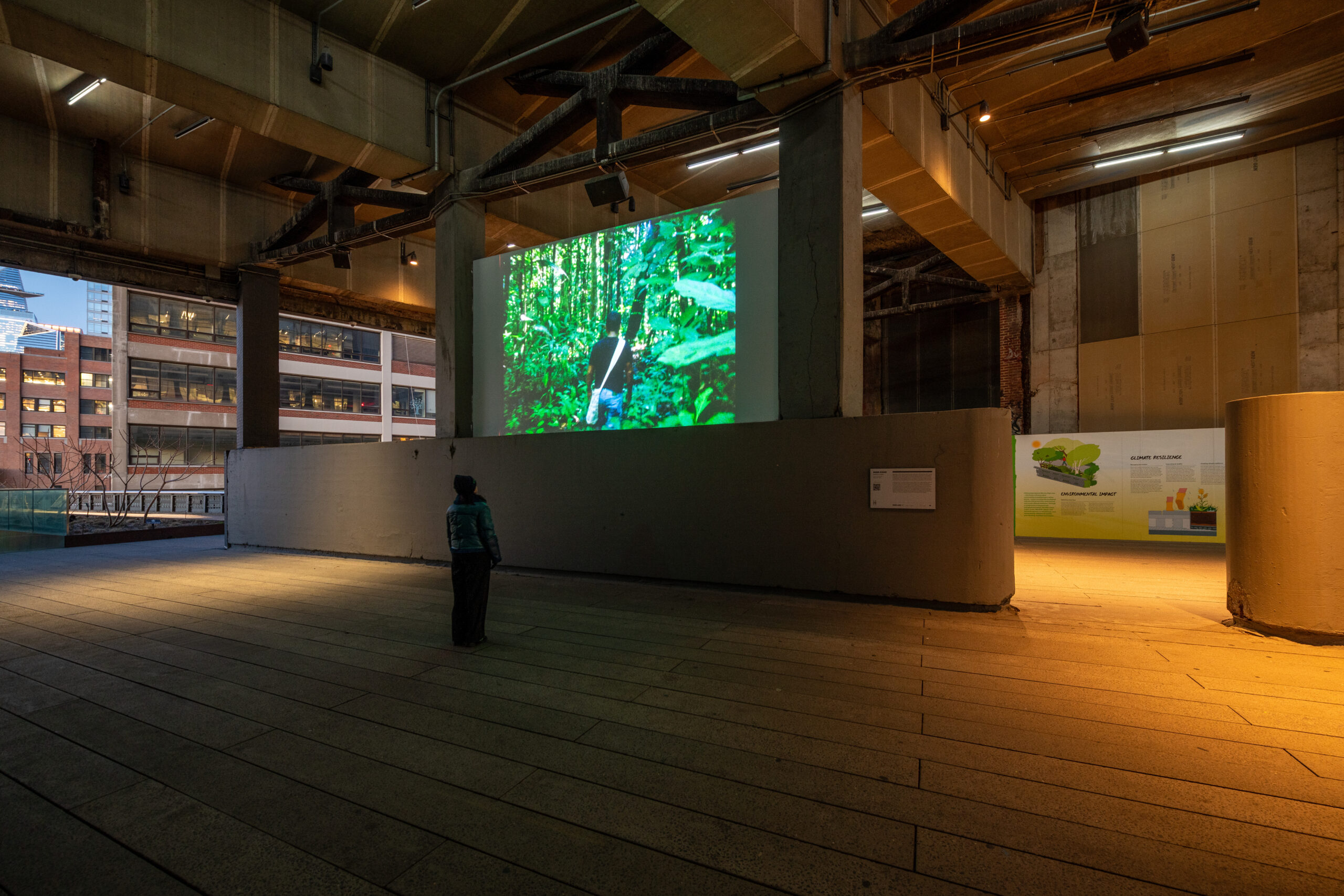
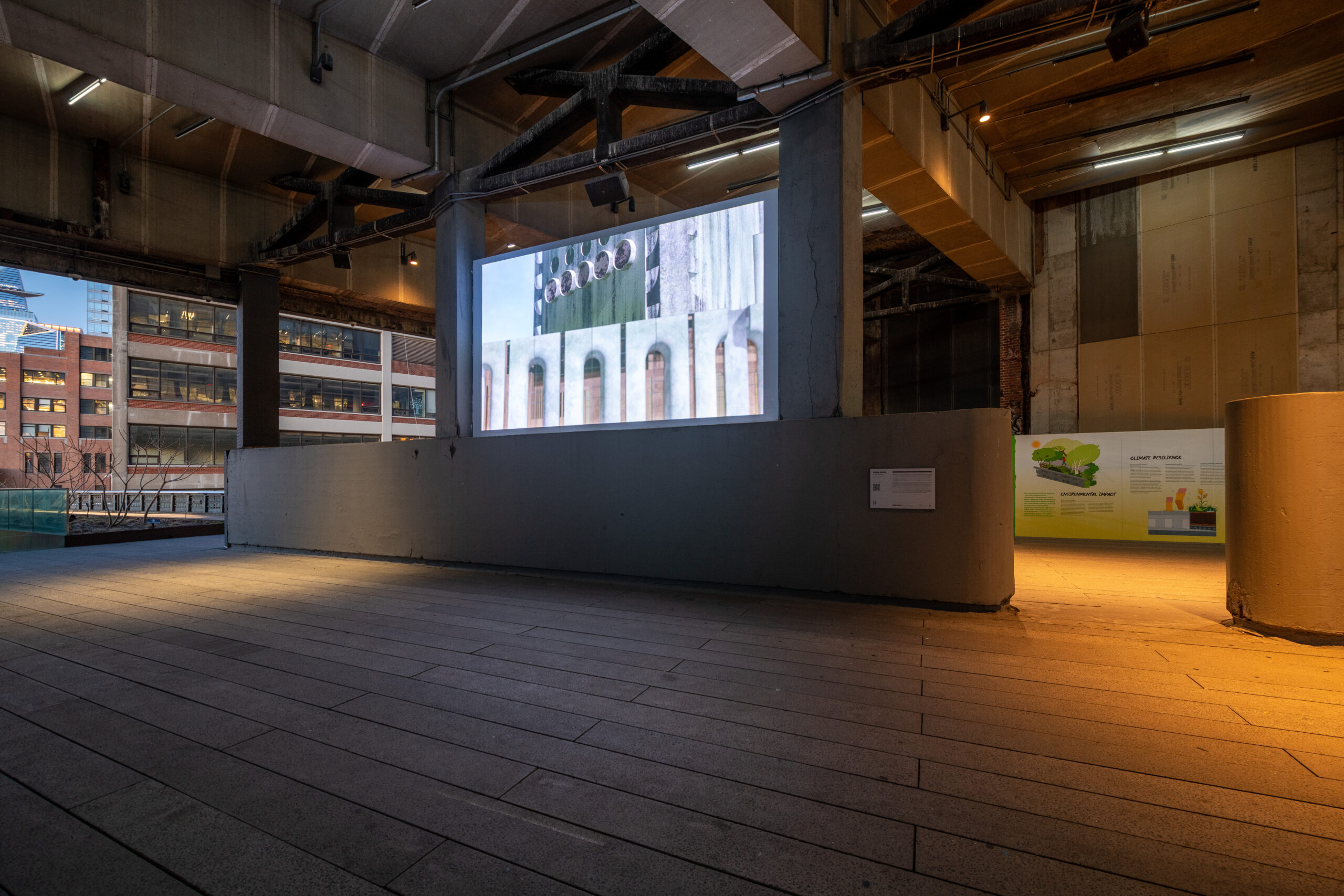
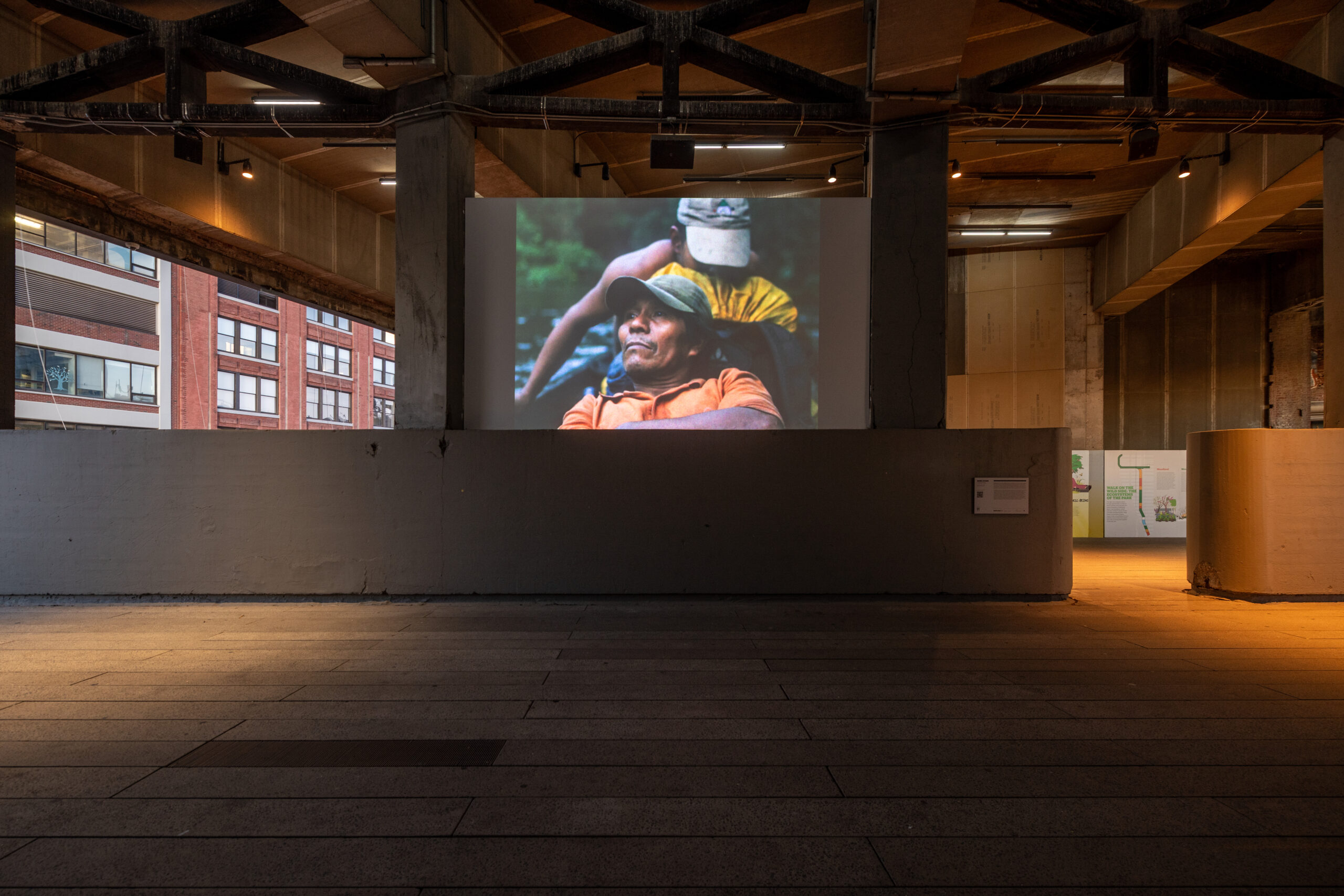
For her High Line Channel exhibition, Huertas Millán presents two video works, Aequador (2012) and The Labyrinth (2018). Rooted in the haunting landscape of the Colombian Amazon, both works explore the historical colonization of nature and the psychological scars of exploitation. Aequador traces a journey upstream in an alternate reality, seemingly parallel to our present. Abandoned futuristic structures dot the terrain like ancient ruins, looming over locals canoeing along the river. Huertas Millán reimagines the rainforest as an ambiguous space, blending past, present, and futuristic fantasy to critique both foreign and internal colonialism. In doing so, she conjures the ghosts of failed Latin American utopias, and illustrates the absurdity and grandiosity of the imposition of modernism in the region.
The Labyrinth offers a psychological and historical descent into the memories of Cristóbal Gómez Abel, a witness to the drug cartels that operated in the Amazon during the 1980s. Following his path between the dense forest and the spectacular, decaying ruins of a narco-mansion—modeled after the Carrington estate from the American soap opera, Dynasty—the film is a hallucinatory account of Gómez’s near-death experience. Huertas Millán draws a powerful parallel between the violence of 20th-century narcocapitalism and the violence of European colonial conquest, ultimately highlighting the enduring strength of precolonial relationships to the land and the possibilities for Indigenous resistance.
Artist bio
Laura Huertas Millán (b. 1983, Bogotá, Colombia) lives and works in Brussels, Belgium. She has held solo exhibitions at institutions including C/O Berlin, Berlin, Germany (2024), Crespo Fondation, Frankfurt, Germany (2025), Museu de Arte de São Paulo (MASP), Brazil (2019), Maison des arts – centre d’art contemporain de Malakoff (2018), and Museo de Arte Moderno de Medellin (MAMM), Colombia (2016). Notable and recent group shows include Becoming Ancestors, Argos, Brussels, Belgium (2026), Woven Histories, MoMA, New York (2025), National Gallery of Art, Washington (2024), and LACMA, Los Angeles (2023), Sembrar la Duda, Banco de la Republica de Colombia (2024), and Future Generation Art Prize, Venice, Italy and Kiev, Ukraine (2019). Huertas Millan’s work has been presented in major international exhibitions, including the Mediacity Biennial, Seoul, South Korea (2025), Sharjah Biennial, Sharjah, UEA (2023), Coimbra Biennial, Coimbra, Portugal (2022), Liverpool Biennial, Liverpool, UK (2021), FRONT Triennial, Cleveland, US (2017). She has been the recipient of numerous awards and fellowships, including the Ulrike Crespo After Nature Prize (2024), the AWARE “Nouveau regard Prize” (2024), a Fontanals Art Fondation (CIFO) Emerging Artist Award (2018), and the Best Direction Prize Pardo di Domani at the Locarno Film Festival (2018).
Support
Lead support for High Line Art comes from Amanda and Don Mullen. Major support is provided by The Brown Foundation, Inc. of Houston, Charina Endowment Fund, and Shelley Fox Aarons and Philip E. Aarons.
>Major support of High Line Art’s digital infrastructure is provided by Bloomberg Philanthropies.
Program support for High Line Art is provided by Sarah Arison, Suzanne Deal Booth, Charlotte Ford, Joyce F. Menschel and Stardust Arts.
Additional support for High Line Art is provided by Agnes Gund and Shane Akeroyd.
High Line Art is supported, in part, with public funds from the New York State Council on the Arts with the support of Governor Kathy Hochul and the New York State Legislature, and the New York City Department of Cultural Affairs in partnership with the New York City Council, under the leadership of Speaker Julie Menin.

Sobre esta obra
Los filmes de Laura Huertas Millán (n. Bogotá, Colombia, 1983) combinan con fluidez imágenes documentales tradicionales con elementos de ciencia ficción, surrealismo y fantasía. Su práctica se basa en un esfuerzo por deconstruir las historias oficiales y las raíces coloniales de la antropología a través de una forma narrativa híbrida que ella misma denominó “ficción etnográfica”.
Para su exposición en el High Line Channel, Huertas Millán presenta dos obras en video: Aequador (2012, 19 min., 42 seg.) y El laberinto (2018, 21 min., 7 seg.). Ambas obras, arraigadas en el paisaje evocador de la Amazonía colombiana, exploran la colonización histórica de la naturaleza y las cicatrices psicológicas de la explotación. Aequador traza un viaje río arriba en una realidad alternativa, aparentemente paralela a nuestro presente. Aquí, la artista evoca los fantasmas de las utopías latinoamericanas fallidas e ilustra la absurdidad y la grandiosidad de la imposición del modernismo en la región.
El laberinto ofrece un descenso psicológico e histórico a los recuerdos de Cristóbal Gómez Abel, quien fue testigo de las operaciones de los cárteles de la droga en la Amazonía durante la década de 1980. Siguiendo su camino entre la densa selva y las ruinas en descomposición de una “narco-mansión”, la película es un relato alucinatorio de la experiencia cercana a la muerte de Gómez. Huertas Millán traza un poderoso paralelo entre la violencia del narcocapitalismo del siglo XX y la violencia de la conquista colonial europea, resaltando la fuerza duradera de las relaciones precoloniales con la tierra y las posibilidades de la resistencia indígena.