Due to heavy rain in the forecast, tonight’s High Line Tour: From Freight to Flowers has been canceled. We look forward to seeing you on a future tour!


your inbox
Sign up for the High Line newsletter for the latest updates, stories, events & more.
Download our Nature in the City Guide
Enter your email to receive a digital copy of our Nature in the City guide to learn more about the complex—and beautiful—ways our park, naturalistic gardens, and sustainable practices support nature in the city
We’ll add you to our list to receive the latest High Line news. If it’s not the right fit for you, you may unsubscribe at any time. Already a High Line email subscriber? Enter your email for access. By providing your information to FHL you agree to the terms of our privacy policy.
Ecological benefits all year long
The High Line’s carefully cultivated gardens are more than just a beautiful space; they are a vital year-round haven, providing critical shelter and nourishment for urban wildlife. This multi-faceted support is evident in the complete life cycle played out within the park’s boundaries—observe, for instance, the fascinating presence of baby bees overwintering in the safety of pithy stems, who later emerge and thrive on the park’s diverse blooms, ensuring the cycle continues.
A lifeline for New York
Why have a purely ornamental garden when you can cultivate one that also strategically supports wildlife, people, and the environment at large? With more than 500 species of plants—half of which are native to the US and 160+ of which are native to New York’s five boroughs—the High Line is the West Side’s lifeline to nature and wildlife. As a green corridor of important habitats, it sustains a thriving ecosystem of people, plants, and animals, including 33 species of bees and many of the 400 birds that visit or call the city home. Beyond its impact on wildlife, the High Line’s gardens help mitigate climate change-related issues, like the urban heat island effect, excessive stormwater, and poor air quality. To top it all off, green spaces like the High Line are critical for human health and well-being, especially for people who live in urban spaces.
Biodiversity & balance
From the tiniest microorganism to a towering magnolia tree, from a hummingbird to a lady beetle, nature assigns each and every living thing a crucial job to do in the web of interconnected and interdependent processes that sustain life. When one species is struggling or absent from an ecosystem, the well-being and survival of all others is threatened. In urban areas, corridors of green space like the High Line provide the habitats that nurture and support the rich biodiversity that sustains healthy ecosystems and environments.
Biodiversity
Noun
Baɪoʊdaɪˈvɜːrsəti
Biodiversity—short for biological diversity—refers to the variety of all life on earth, and the variability of living organisms in a specific place. Biodiversity can be measured by the number of species in a given location, and is a key indicator of an ecosystem’s health and resilience. Strong ecosystems have rich and complex biodiversity, which enables them to better resist disease and adaptto changing environments.
Birds
Avian visitors to the High Line make their home in attractive nesting habitats like the Thicket’s forest of dogwoods, redbuds, hollies, witchhazels, and sassafras trees (at 21st Street), while feasting on a yearround menu of berries and seeds offered by bottlebrush buckeye, holly, and rose shrubs. This reliable supply of shelter and nourishment from our four-season gardens are an invitation to the more than 400 species of resident and visiting birds in New York City.
A 2017 study conducted by the American Museum of Natural History identified 33 species of bees on the High Line. Unlike widely known honeybees, which are not indigenous to North America and reside in hives with a queen, most of the bees on the High Line were determined to be solitary native varieties that build their nests in the ground, cavities, and hollow plant stems. Only our native bumblebees live in social nests, repurposing existing cavities, usually in the ground, with a queen bee and around 50 workers. Our diverse selection of native flowering plants, water sources, and habitat options make our naturalistic gardens particularly attractive to native pollinators such as these, bolstering an ecosystem in accordance with nature’s design.
Birds
Avian visitors to the High Line make their home in attractive nesting habitats like the Thicket’s forest of dogwoods, redbuds, hollies, witchhazels, and sassafras trees (at 21st Street), while feasting on a yearround menu of berries and seeds offered by bottlebrush buckeye, holly, and rose shrubs. This reliable supply of shelter and nourishment from our four-season gardens are an invitation to the more than 400 species of resident and visiting birds in New York City.
A 2017 study conducted by the American Museum of Natural History identified 33 species of bees on the High Line. Unlike widely known honeybees, which are not indigenous to North America and reside in hives with a queen, most of the bees on the High Line were determined to be solitary native varieties that build their nests in the ground, cavities, and hollow plant stems. Only our native bumblebees live in social nests, repurposing existing cavities, usually in the ground, with a queen bee and around 50 workers. Our diverse selection of native flowering plants, water sources, and habitat options make our naturalistic gardens particularly attractive to native pollinators such as these, bolstering an ecosystem in accordance with nature’s design.
Pollinators
Pollinators can’t resist the bountiful blossoms of the High Line’s fourseason gardens. More than 33 species of bees—as well as other pollinators and niche insects—inhabit our gardens, which bloom yearround to provide reliable sources
of nectar, nourishment, and shelter. Because our pollinator pals choose to overwinter here, the High Line does not cut back its gardens in the fall, and is careful to leave the plants providing their food and shelter until the spring.
Pollinators
Pollinators can’t resist the bountiful blossoms of the High Line’s fourseason gardens. More than 33 species of bees—as well as other pollinators and niche insects—inhabit our gardens, which bloom yearround to provide reliable sources
of nectar, nourishment, and shelter. Because our pollinator pals choose to overwinter here, the High Line does not cut back its gardens in the fall, and is careful to leave the plants providing their food and shelter until the spring.
Beneficial Insects
Insects are the essential workers of healthy ecosystems and the foundation of the food chain. They pollinate food-producing plants, cycle nutrients back into the soil, and serve as nourishment for birds. These hard working bees and other insects love nesting in the High Line’s nurturing habitats. The dense leaf litter of our tree canopy provides a welcome home for lady beetles and aphid lions, which hunt and devour sap-sucking aphids that can transmit diseases to plants.
Beneficial Insects
Insects are the essential workers of healthy ecosystems and the foundation of the food chain. They pollinate food-producing plants, cycle nutrients back into the soil, and serve as nourishment for birds. These hard working bees and other insects love nesting in the High Line’s nurturing habitats. The dense leaf litter of our tree canopy provides a welcome home for lady beetles and aphid lions, which hunt and devour sap-sucking aphids that can transmit diseases to plants.
Environmental Impact
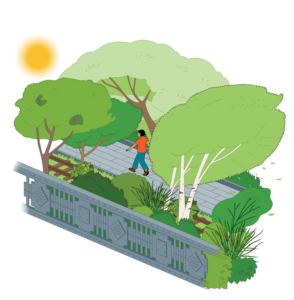
Urban green spaces like the High Line—that feature diverse plant communities including many native plants—restore to cities the ecological systems that protect the environment and create climate resiliency. Through a combination of physical and biological processes, the High Line’s 1,340+ trees, 150,000+ plants, and soil work together to absorb heat, cool temperatures, improve air quality, slow flooding, and filter stormwater.
Reducing Urban Heat
The gray birch and serviceberry trees of the Gansevoort Woodland and the Flyover’s shady grove of big leaf magnolias are among the more than 1,340 trees that form the High Line’s tree canopy. These hard-working trees cast cooling shade and block the sun from warming the earth. Through the process of transpiration, plants also release cooling water vapor into the air, while other moisture enters the air when water evaporates off of leaf surfaces and soil. The combination of these processes, through which plants work together to cool the air, is known as evapotranspiration. As a result, on average the urban heat island effect is reduced by 7.2°F (and up to 8.1°F!) along the High Line, compared to the surrounding neighborhoods, according to a recent study by Climate Central.
Health & Mental Well-Being
Supporting Human Health
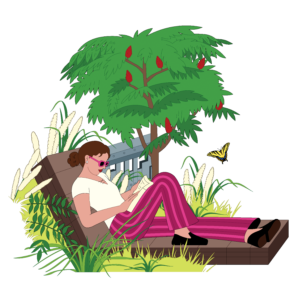 Access to green space is an important determinant of health, and the High Line’s serene and tranquil natural environments offer New York’s citydwellers a garden oasis where they can experience the substantial physical and mental health benefits human beings derive from nature. Studies show that just a short visit to a park soothes stress, boosts mood, relieves anxiety and depression, lowers blood pressure and cortisol levels, mitigates feelings of loneliness, and promotes a sense of well-being. Visitors to the High Line can find quiet among the noise-buffering gray birches of the Gansevoort Woodland, soak in the Sundeck’s calming views of the Hudson River, inhale the cooler, clean air, meditate among the undulating blossoms, and restorative scents of the Thicket’s woodland forest, or get their hearts pumping with a stroll through the park’s approximately 1.5 miles of stunning garden zones.
Climate Resilience
Managing Storm Water
Impervious surfaces like pavement and concrete cannot absorb water. As storms become more severe, managing stormwater run-off is a growing challenge for cities. Trees, plants, and soil are natural stormwater mitigation and filtration systems. Tree canopies block water from reaching the ground, while their roots create canals that enable soil to drink up more of the run-off that can cause flooding and damage.
The High Line forms a green roof over the West Side, absorbing rain water through a multilayered drainage system. Rain that falls on our concrete pathways slips through the gaps in the planks and must migrate through the soil in the planting beds before it can reach the storm drain. This allows the soil, plant roots, and the drainage mat to absorb as much water as possible before sending the excess to the drain. This greatly reduces the stormwater that escapes the High Line and conserves water in our gardens.
Improving Air Quality
Working together, trees and plants form nature’s own air conditioning systems. Not only do they cool the air, but they clean it by hungrily consuming carbon dioxide. According to a 2017 study from Columbia University, the High Line’s tree canopy sequestered 1.3 tons of atmospheric carbon annually. Since then, the High Line has been steadily revving up its carbon capture, nearly doubling the number of trees in the park.
A subsequent 2023 study revealed New York’s trees and plants absorb 40% of the city’s CO2 emissions.
Creating Climate Resilience
The elevated nature of the High Line means our native and ornamental plants must thrive in challenging conditions—exposed to temperature swings, wind, and fluctuations in moisture that are more extreme than at street level. And all in primarily 18 inches of soil! For this reason, the High Line’s gardens are an excellent lab for finding resilient plants that will do well as climate change creates more unpredictability and weather extremes, all while making a net positive environmental impact.
Our horticulturists also minimize inputs: Our gardens’ beautiful displays are done without pesticides or chemical fertilizers—primarily using compost!—or excessive watering, removing those negative environmental impacts that can come with conventional commercial landcare.
Walk on the Wild Side: The Ecosystems of the Park
The High Line transports visitors through 1.5 miles of distinct garden zones that echo the native ecosystems of Manhattan Island—vast grasslands, coastal wetlands, thickets of woody shrubs, and shady woodland forests. These vibrant communities of plants, insects, birds and pollinators thrive in authentic environments and support each other by being linked together on the High Line.
Urban Ecology
noun
ˈɜːrbən iˈkɒlədʒi
Urban ecology is the science and study of how living things—people, plants, and animals—relate and interact with each other and their physical surroundings in cities and urban environments. An urban ecosystem includes the community of people, plants and animals that live in cities, but also the built environment of buildings, bridges, roads, sewers, and other structures that impact natural environments and influence how organisms behave. The study of urban ecology enables urban planners to design and build healthier, more sustainable cities.
Grassland
Grasslands are wide, open spaces of undulating prairie grasses and herbaceous plants like wildflowers, devoid of trees and woody shrubs. Here, you will be dazzled by the stunning variety of grasses and flowering shrubs and perennials—like our iconic coneflowers and rattlesnake master. Not only do they provide the High Line with four seasons of vibrant color, they serve up a year-round supply of nourishing seeds and nectar to buzzing populations of hummingbirds, native bees, and other pollinators. In an urban area like New York, the five grassland zones of the High Line are efficient engines of climate resiliency, absorbing copious amounts of carbon, heat, and stormwater.
Grassland
Grasslands are wide, open spaces of undulating prairie grasses and herbaceous plants like wildflowers, devoid of trees and woody shrubs. Here, you will be dazzled by the stunning variety of grasses and flowering shrubs and perennials—like our iconic coneflowers and rattlesnake master. Not only do they provide the High Line with four seasons of vibrant color, they serve up a year-round supply of nourishing seeds and nectar to buzzing populations of hummingbirds, native bees, and other pollinators. In an urban area like New York, the five grassland zones of the High Line are efficient engines of climate resiliency, absorbing copious amounts of carbon, heat, and stormwater.
Wetland
A manmade water feature on the High Line’s Sundeck provides a friendly watering hole for thirsty insects and a splash pad for humans looking to cool their heels (and toes) on a summer day. It also creates wetland conditions where moisture-loving plants like swamp milkweed, blue flag iris, and swamp rose mallow flourish. During the hot and dry summer months, bees, butterflies, and other insects seeking a water source on New York’s urban heat island are drawn to this wetland. The buttonbush—hugely popular with pollinators and almost all varieties of butterflies—is also the host plant for North America’s largest moths.
Wetland
A manmade water feature on the High Line’s Sundeck provides a friendly watering hole for thirsty insects and a splash pad for humans looking to cool their heels (and toes) on a summer day. It also creates wetland conditions where moisture-loving plants like swamp milkweed, blue flag iris, and swamp rose mallow flourish. During the hot and dry summer months, bees, butterflies, and other insects seeking a water source on New York’s urban heat island are drawn to this wetland. The buttonbush—hugely popular with pollinators and almost all varieties of butterflies—is also the host plant for North America’s largest moths.
Woodland edge
As denser forest gives way to more open spaces, many species of wildlife make their home in the thickets of woody shrubs and shade-tolerant grasses at the woodland’s edge. The High Line emulates these fascinating ecosystems throughout the park. In the Chelsea Thicket, the tasty red berries of the dogwood trees attract robins, blue jays, and other avian visitors in summer and fall, while low-grow aromatic sumac hosts moth and butterfly larvae—which feed on the shrub’s citrusy fruit. Shrub thickets present ideal nesting locations for a variety of birds. We’ve spotted robins, mockingbirds, and mourning doves nurturing their next generations here. The Woodland Edge features early blooming witch hazel and native chokecherry, which attracts bees, beetles, butterflies, and the lunate zale moth.
Woodland edge
As denser forest gives way to more open spaces, many species of wildlife make their home in the thickets of woody shrubs and shade-tolerant grasses at the woodland’s edge. The High Line emulates these fascinating ecosystems throughout the park. In the Chelsea Thicket, the tasty red berries of the dogwood trees attract robins, blue jays, and other avian visitors in summer and fall, while low-grow aromatic sumac hosts moth and butterfly larvae—which feed on the shrub’s citrusy fruit. Shrub thickets present ideal nesting locations for a variety of birds. We’ve spotted robins, mockingbirds, and mourning doves nurturing their next generations here. The Woodland Edge features early blooming witch hazel and native chokecherry, which attracts bees, beetles, butterflies, and the lunate zale moth.
Woodland
A woodland is a low-density forest populated by trees and woody shrubs and characterized by the wider spacing of trees. This allows sunlight to reach the earth and support a healthy understory—the shrubs and vines beneath a tree canopy that provide habitats for wildlife. The High Line features several of these important ecosystems, miniature forests thriving above New York’s West Side. Mockingbirds and sparrows flock to the Gansevoort Woodland’s serviceberry and gray birch trees, where bees, beetles, flower flies, and butterflies sip from the blooms of Amethyst Falls American wisteria. Beneath the Flyover’s canopy of big leaf magnolias, sassafras, and serviceberry trees, a thriving understory of flowering plants is abuzz with pollinators, including a wide variety of long-tongued bees.
Woodland
A woodland is a low-density forest populated by trees and woody shrubs and characterized by the wider spacing of trees. This allows sunlight to reach the earth and support a healthy understory—the shrubs and vines beneath a tree canopy that provide habitats for wildlife. The High Line features several of these important ecosystems, miniature forests thriving above New York’s West Side. Mockingbirds and sparrows flock to the Gansevoort Woodland’s serviceberry and gray birch trees, where bees, beetles, flower flies, and butterflies sip from the blooms of Amethyst Falls American wisteria. Beneath the Flyover’s canopy of big leaf magnolias, sassafras, and serviceberry trees, a thriving understory of flowering plants is abuzz with pollinators, including a wide variety of long-tongued bees.
The High Line’s Hidden World
The High Line’s naturalistic gardens were inspired by the self-seeded landscape that had sprouted up on the rail track, but are wild by design—the result of painstaking planning, care, and cultivation by our expert horticulture team.
Creating Sustainable, Climate-Resilent Gardens
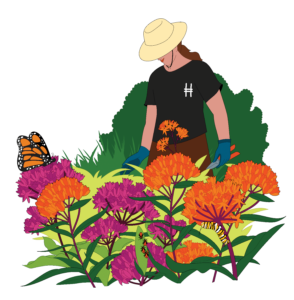
Mindful of how plants behave in the High Line’s unique growing conditions, the horticulture team creates sustainable and climate-resilient gardens by planting a diverse selection of plants. Our horticulturists incorporate native and drought-resistant plants that perform important ecological functions like attracting beneficial insects or “fixing nitrogen” by converting atmospheric nitrogen into plant food. They also do a great job managing noxious, weedy plants and use Integrated Pest Management—a chemical-free, environmentally sound method of pest prevention and control—to safeguard our gardens and visitors from unwelcome critters.
Saving Seeds & Propagating Plants
By collecting and saving seeds from our gardens, Friends of the High Line’s horticulture team can propagate our own plants on site. This reduces our carbon footprint, allows us to grow rare plants that are difficult to source, and supports ecotypes—plants that have adapted specifically to the High Line. We share these seeds with horticulture professionals across New York City and collect rainwater at 34th Street to water the plants we’re propagating.
Using Advanced Irrigation Technology
The High Line’s green-roof drainage system helps to capture and hold stormwater. Moisture and precipitation sensors in our plant beds are connected to web-based irrigation controllers, relaying real-time data to our horticulture team. This ensures that watering is precisely targeted and limited to only what is absolutely necessary.
Maintaining Biodiversity
As stewards of a complex ecosystem of plants, insects, pollinators, birds, and people, the High Line’s horticulture team cultivates and protects the park’s vibrant biodiversity with ecological horticultural practices. Chemical insecticides and herbicides are never used, and plant selection favors native species—like the milkweeds that support Monarch butterflies.
Thoughtful tree pruning allows rain and sunlight to nourish our understory, while plants providing habitats and food sources for birds and insects are allowed to overwinter and remain undisturbed until the Spring Cutback. The debris from the cutback is then returned to the planting beds as compost to enrich soil biodiversity. The beauty and experience of the park—along with our mentoring of the next generation of horticulturists—ensures our ecosystem attracts and maintains a healthy population of human beings.
Engaging Nature
Engaging Nature: Dialogues on Urban Ecology, is a four-part virtual public program series that illuminated the practices and expertise driving the High Line’s contributions to the domains of ecological horticulture, urban biodiversity, and climate resilience. The series launched on Earth Day 2025, April 22, at 6pm with a conversation between ecological garden designer and Harvard Loeb Fellow Rebecca McMackin and Richard Hayden, High Line Senior Director of Horticulture, about ecological horticulture.
Through the Engaging Nature: Dialogues on Urban Ecology series, attendees learned about the often-overlooked connections between plants, humans, wildlife, and the many elements that make up the natural world around us within the built environment of New York City. From best practices for fostering a holistically healthy garden and recent learnings on the vital partnerships between native pollinators and plants that allow them both to thrive, to insights on horticultural resilience in the face of a changing climate and the care and keeping of some of New York City’s most vibrant greenspaces, the Engaging Nature dialogues reveals the role we play within the complex and unseen system of networks that undergirds the urban environment.
Adventures in Ecological Horticulture
Virtual discussion
Tuesday, April 22, 2025
6 – 7pm
Ecologically focused horticulturist Rebecca McMackin, former Director of Horticulture at Brooklyn Bridge Park and current Lead Horticulturist for the American Horticultural Society, shares insights from her work in urban green spaces on how to cultivate beautiful and biodiverse gardens, followed by a Q&A with High Line Senior Director of Horticulture Richard Hayden.
See the recording:
Living Landscapes: Supporting Pollinators with Plants and Practices
Virtual discussion
Wednesday, June 18, 2025
6 – 7pm
Learn how gardens and urban green spaces support native pollinators with experts Sarah Kornbluth (American Museum of Natural History) and Sam Hoadley (Mt. Cuba Center). They discuss native bee surveys, horticultural techniques, and plant trials, followed by a Q&A with the High Line Senior Director of Horticulture Richard Hayden.
See the recording:
Future Nature: Rethinking Public Landscapes as Living Infrastructure
Wednesday, October 15, 2025
6 – 7:30pm EDT
Livestream event
Broadcast from the High Line Network Policy Lab
Thomas Rainer is a leading voice in ecological landscape design and co-author of Planting in a Post-Wild World. Thomas challenges traditional approaches to urban green spaces and advocates for dynamic plant systems designed for climate resilience. Drawing on his own work in the field, he shared how landscapes like the High Line are moving beyond ornamental gardens to become self-sustaining, adaptive ecosystems that thrive amid environmental stress—transforming our parks and public spaces into vital habitats for a greener future. Thomas was joined in conversation by Azzurra Cox, a landscape architect and assistant professor at the University of Pennsylvania who studies how urban green spaces foster collective memory and belonging.
October’s event in the series was livestreamed from the High Line Network’s third annual Policy Lab, a three-day convening for professionals working on public infrastructure reuse projects that will center on practices in urban ecology—exploring approaches to design, programming, and stewardship that reconnect people, nature, and place.
Celebrating City Nature: Insights from NYC Greenspaces
Wednesday, December 3, 2025
6– 7:30pm
Virtual panel discussion
Margaret Roach, celebrated New York Times garden columnist and “A Way to Garden” podcast host, guided a dynamic panel of NYC’s green space visionaries. Together, they explored leading-edge strategies for cultivating urban parks as thriving ecosystems, and revealed how to ignite public passion for nature access and vital green infrastructure. Participants included the High Line’s Senior Horticulture Manager, Yuki Kaneko; Rashid Poulson, Director of Horticulture at Brooklyn Bridge Park; and Sara Evans, Director of Living Collections, Green-Wood Cemetery.
Margaret Roach is a longtime garden writer—previously for Martha Stewart Living (where she became the company’s EVP/Editorial Director), and now a garden columnist for The New York Times. She also creates a website, podcast, and weekly newsletter called “A Way to Garden,” the title of her 1998 book that was reissued in 2019 in an all-new edition. She has been honored for her contributions to horticulture with the George Robert White Medal of Honor from the Massachusetts Horticultural Society, and the Scott Medal from Scott Arboretum at Swarthmore, among other awards.
Support the High Line
Nearly 100% of the park’s budget comes from friends like you. Please support our urban green space with a donation, ensuring our gardens continue to thrive and provide ecological benefits to New York City year after year.
Become a memberSupport
Lead support for Horticulture on the High Line is provided by Amanda M. Burden.
Major support of High Line Horticulture digital infrastructure is provided by Bloomberg Philanthropies.
Program support for Horticulture on the High Line is provided by Con Edison, Greenacre Foundation, Farvue Foundation, and Christine Knuth.
Engaging Nature: Dialogues on Urban Ecology, is made possible, in part, with endowment funds from the Diamonstein-Spielvogel Foundation. Additional support provided by Dana Niblack and Paul Thompson.

Illustrations by Jiaqi Wang.